
Guitar scales are hard to memorise. There are a lot of them and many of them are very similar – with only one or two notes’ difference.
And just when you think you’ve got the hang of them, you have to shift them into different keys — which can sometimes feel like you’re starting again!
If any of that sounds familiar, you’re in good company. It’s one of the most common challenges I see with students at every level of their playing.
So in this article, I want to share three exercises that I use myself and that I use with students on a regular basis. These exercises will help you to consolidate your guitar scales at a deep level, learn how to use them in your playing, and also freshen up your practice routine.
This last point is important, because practicing scales can get stale if you’re always drilling them in exactly the same way.
Before we dive into the exercises themselves, there are three quick things to cover which apply to all of them. These are as follows:
1. These exercises work with any scale — I’m using the G minor pentatonic scale to illustrate each one here. But you can apply the same approach to any scale you’re working on: whether that’s the major scale, the natural minor, the harmonic minor, the major pentatonic or the blues scale etc.
2. Always use a metronome — You will get so much more benefit from practicing guitar skills when you use a metronome. This is simply because it develops your rhythmic accuracy, which is one of the most important skills you can have as a guitarist. I cannot stress this enough.
3. These exercises double as technical drills. With your metronome at a relaxed pace, playing eighth notes, these work brilliantly as a warm-up. Alternatively, if you shift to sixteenth notes or push the tempo up they become genuine technical exercises — great for building speed and synchronicity between both hands.
With those initial points out of the way, let’s get into the exercises themselves:
Exercise I – Flashcard mode
This first exercise is nice and simple. Instead of always practicing your guitar scales starting with shape 1, then 2, then 3, then 4, then 5 — you mix the order up completely and move through the shapes in a random sequence.
So for example, you might start in shape 3, move to shape 5, drop down to shape 2, and so on. There is no set order — the whole point is that you are jumping around unpredictably.
Here are the 5 shapes of the G minor pentatonic scale to help you practice jumping between them:
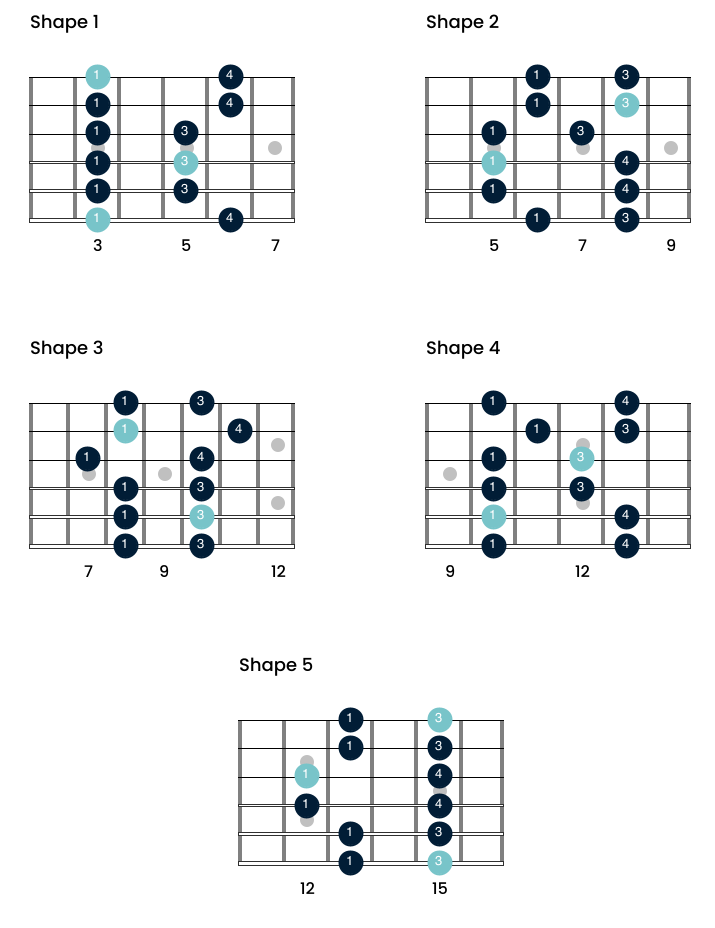
These diagrams show my suggested fingerings, and the tonic notes of G are highlighted in light blue.
If you are used to always starting your guitar scale practice in shape 1, you’ll be surprised at how challenging this feels. But there are two really practical benefits that make it worth the initial discomfort.
Benefit 1: You stop thinking in relation to shape 1
So often when I work with players 1-1 and I ask them to jump to shape 3, I can literally see them working up from shape 1 in their mind. They go ‘okay, shape 1 is here, shape 2 is here… so shape 3 must be…’ — and it takes that little bit of time.
That’s not very useful in a real playing situation. When you’re soloing, you need to be able to access any shape freely and immediately, without having to count up from the beginning. Practicing in this random way forces you to think about each shape on its own terms.
Benefit 2: You learn all five shapes
If you always start by practicing shape 1, that’s where most of your attention goes and shapes 4 and 5 tend to get neglected.
By mixing things up, the focus spreads evenly — and most players find they get comfortable with the less familiar shapes much faster than expected.
Exercise II: The shape shifter
This second exercise has two brilliant benefits. The first is that it gets you thinking about the shape of your guitar scale rather than where it sits in a specific key.
It’s very easy as blues players to get comfortable in one or two keys — A and E being the most common — and to suddenly feel lost when you shift to an unfamiliar key.
By moving chromatically up the fretboard as this exercise requires, you stop thinking about the scale in any particular key and start thinking purely about the shape itself. That is an enormously valuable shift in perspective.
The second benefit is that the motion is constant. You’re playing up and down the fretboard without stopping, which makes it an outstanding technical exercise for building stamina and synchronicity between both hands.
Here’s what it looks like using the first shape of the minor pentatonic scale, starting at the 3rd fret:

At 90 BPM, this is how the exercise sounds:
To perform this exercise, you need to shift up a fret every time you reach either the high or low E string.
So when you reach the top E string, rather than playing back down to the beginning of the scale, you shift up one fret and then descend the scale shape from there.
When you reach the low E string, you shift up another fret and ascend the scale again. Repeat this all the way up the fretboard — I typically go up to around the 12th or 14th fret — and then work back down again.
When you do go back down, the process is the same but in reverse. So here, every time you get to either the low or high E string, you shift down a fret.
As a guideline, in the video above I play this exercise at around 90bpm (and the audio above is played at this pace) — but you can easily reduce this to feel more comfortable, or push the tempo once you build confidence with the exercise.
Exercise III – The pentatonic rollercoaster
This is my personal favourite of the three, and the one I’d encourage you to spend a little extra time on if you really want to nail your guitar scales. This is because it has two significant benefits that set it apart from the previous exercises.
First, like the shape shifter, it builds stamina and synchronicity because you’re working through all five scale shapes without stopping. This is great for your technique and your ability to play consistently over a longer period of time.
The second benefit is more significant. One of the common criticisms of exercises that help you practice guitar scales is that they don’t sound or feel musical — you’re just running up and down patterns.
Here, the movement between shapes starts to mirror what you’d actually do in a solo. You begin to hear how the shapes connect, and how you might move between them when improvising.
This is what this exercise looks like using the G minor pentatonic scale:

At 90 BPM, this is how the exercise sounds:
In this exercise, you start with the first shape of the scale and ascend from the bottom to the top.
When you reach the top, rather than descending back down the first scale shape, you shift up and into the top of shape 2 and descend down the second scale shape from there.
When you reach the bottom of shape 2, you then shift into the bottom of shape 3 and ascend and so on.
A note on fingering
The main thing to watch out for here is that your fingering doesn’t get mixed as you transition from one shape of the scale to the next. Take the shift from shape 1 to shape 2 as an example. Depending on how you finger the top of shape 2, you may need to make a small adjustment as you arrive at that position.
My recommendation is to be deliberate about your fingering from the start and keep it consistent throughout. The transition point between shapes is where players most commonly trip up, so think ahead rather than reacting when you get there.
(As a brief aside — I personally use my ring and first finger at the top of shape 2, rather than the slightly more economical middle and little finger. This is because in practical blues playing, that position is where I’ll typically be bending and using bluesy techniques. So it’s good practice for me to have those fingers in place).
Closing thoughts
Finally, here are a few closing ideas to keep in mind as you work through these exercises:
1.) You don’t need to practice all three exercises at the same time. Pick one, run with it for a couple of weeks until it feels solid, and then rotate in one of the others. There’s no rush, and when it comes to learning your guitar scales, consistency over time is far more valuable than trying to cram everything into a single session.
2.) Prioritise clean technique over speed. This isn’t a race. You want to be locked in to the metronome, playing with a relaxed but accurate technique, using alternate picking throughout. Sloppy scales don’t consolidate anything — they just engrain bad habits.
3.) Use these as technical exercises when you’re ready. Once the scale shapes and exercises feel comfortable, push the metronome up a little. Small increments, consistently applied, add up quickly. This is exactly the kind of work that builds the synchronicity and speed you hear in players like Joe Bonamassa, Stevie Ray Vaughan, and Rory Gallagher.
4.) Try these in different keys and with different scales. Once you’re comfortable using the G minor pentatonic, take the same exercises and apply them to the keys of A, E, or wherever else you want to work. Then try them with the blues scale, or the major pentatonic. The method is the same — only the material changes.
If you want to go further with your scale knowledge, you might also find these articles useful:
As always, let me know how you get on with this — drop a comment below or send me an email on aidan@happybluesman.com. I’d love to hear how they’re working for you. Good luck! 😁




Responses