
“Texas Flood” is one of my favourite Stevie Ray Vaughan songs, and one that I think gives you fresh inspiration and new ideas every time you return to it.
Whether you want to jam over the track, develop a slow blues vocabulary of your own, or simply understand what makes SRV’s playing so compelling, there is so much to take from this song.
There are so many different ideas we could pull from this track, but in this lesson we’re going to focus on three things that you can work on today to bring your slow blues playing to life and add a bit of that Stevie magic into the mix at the same time.
Let’s get into it!
I – The Texas Flood chord progression
On the original recording of “Texas Flood”, there is very little in the way of rhythm guitar. Bass player Tommy Shannon is outlining the harmony in his playing, and Vaughan is mostly playing lead with the occasional chord or double stop added in.
Despite this, I think we can use the song as an interesting study, as it is more complex than a standard 12 bar, which makes it a brilliant exercise for developing your ability to track changes and move between chord shapes quickly.
A standard 12 bar blues progression would look like this:
I I I I
IV IV I I
V IV I V
A “quick change” would be almost identical, the only difference being that it would move to the IV chord in the second bar.
In Texas Flood though, there are more chord changes to follow and these happen quite quickly.
This is what the intro looks like:
I IV I/V I/V
*In the video above I wrongly state that the final chord in that progression is a I/IV. It is not – the progression ends on the V chord in the intro.
In each instance you see a “/” it indicates that multiple chords appear in a single bar. So in both bars three and four, you play two chords, rather than simply holding onto one chord as you would in a regular 12 bar progression.
After that, the main progression in the song runs as follows:
I IV I I
IV IV I I
V IV I/IV I/V
So the main 12 bar includes a quick change, and the turnaround breaks into more rapid chord movements rather than the simpler V → IV → I → V pattern you’d typically encounter.
If you’d like to practice the progression and put together a more full rhythm part, then in standard tuning the track is played in G, and I typically default to using these chord voicings:
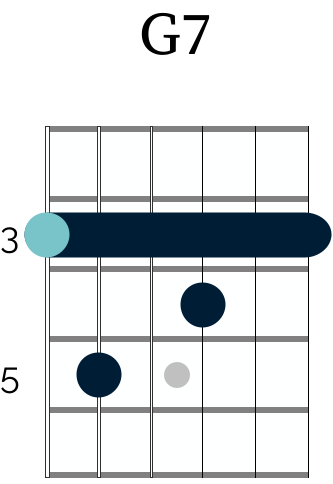
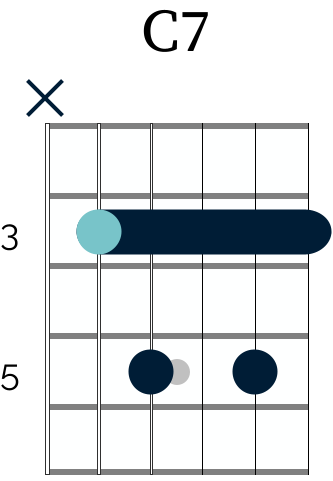
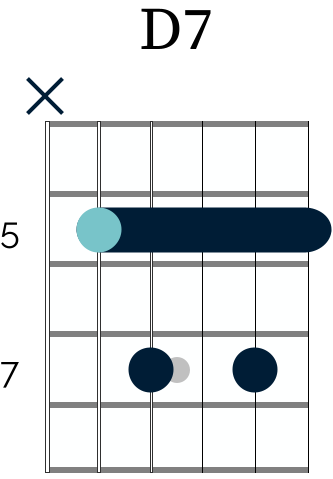
However you can (and should) mix things up, and also think about playing the C7 and D7 using these voicings:
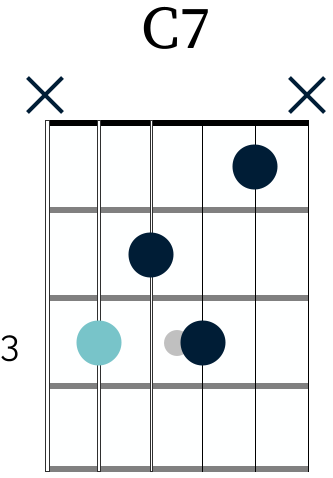
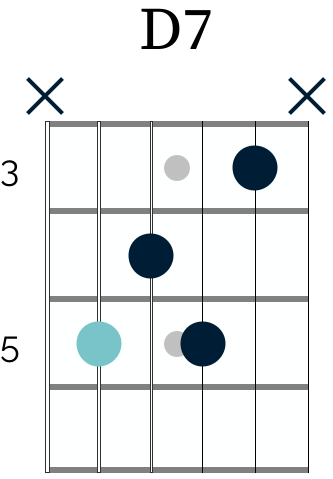
Tracking all of those changes cleanly with a complete rhythm part is a brilliant way to build fluency with your dominant 7th chords and a slightly more complex progression.
II – Mixing major and minor Pentatonics: SRV style
There are so many awesome elements of Vaughan’s lead playing that we could analyse here.
However we can get a long way in creating the same feel in our playing by mixing the major and minor pentatonic and doing this in two specific positions.
The first of these is the Albert King Box. In the key of G, it looks like this:
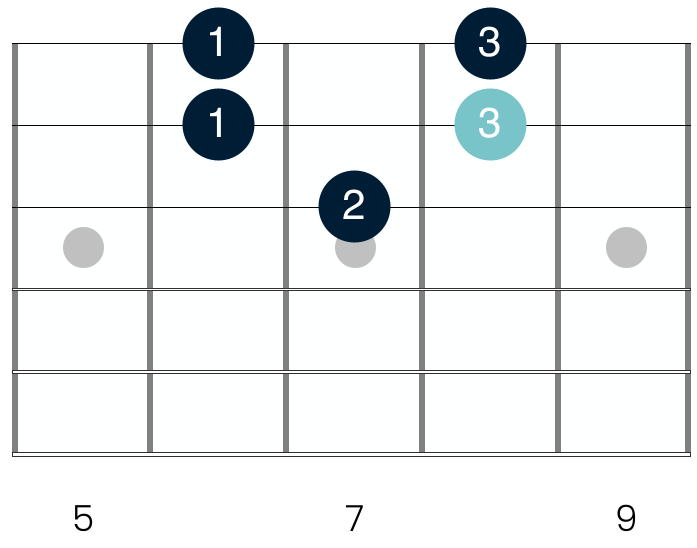
In reality this is nothing more than a collection of 5 notes from the top 3 strings of the second shape of the minor pentatonic scale.
However by using the fingerings suggested above you can get a huge amount of mileage from those notes by bending pretty much all of the notes in the contained box shape.
Vaughan also uses the box a lot in his playing, and he adds a bit of extra magic to it by adding in one more note on the high E string:
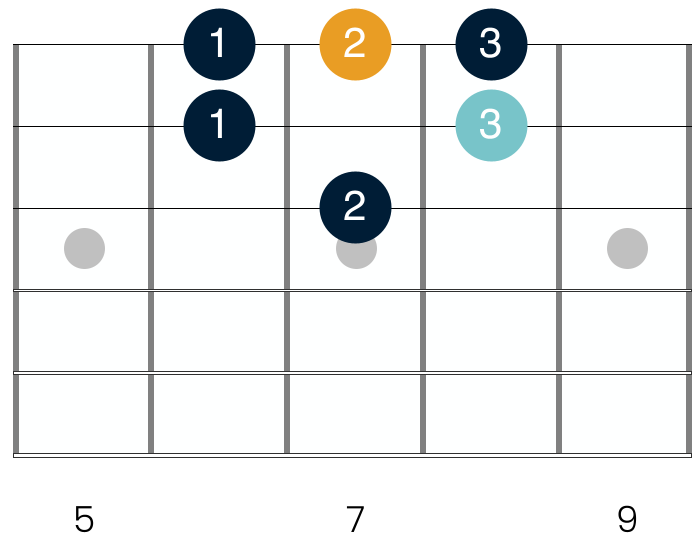
Highlighted in orange, this note is the major 3rd from the major pentatonic scale. This turns the box from being purely minor into a mix of major and minor.
And by continuing to use bends — targeting that note by bending up to it from the 6th fret, or landing on it and bending it up a semitone to the 8th fret — you can mix the major and minor sounds in a very smooth and musical way that immediately captures SRV’s style.
In the first minor pentatonic shape, Vaughan adds two extra notes that bring a strong major flavour, both of which are highlighted in orange below:
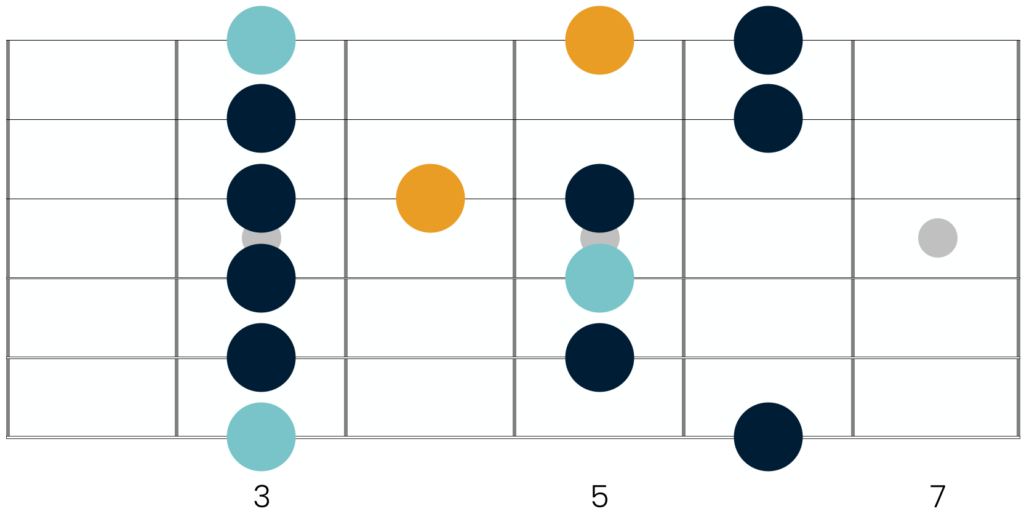
The new note on the 4th fret of the G string is the major third interval. This is the strongest flavour from the major pentatonic and one which will immediately bring a warmer and sweeter sound into the playing.
The note at the 5th fret on the high E string is the major second, or 9th when moved up an octave. This is a very versatile note that appears in a range of both major and minor scales.
It’s a new and different flavour and one that will move you beyond a more traditional blues sound.
The key to adding these notes in whilst still sounding like Vaughan is to focus on using them sparingly. Focus almost all of your phrasing around the minor pentatonic scale, and from there dip out and target these notes occasionally.
This will bring new flavours into the mix, without compromising the power and aggression central to Vaughan’s style.
III – Targeting chord tones like Stevie Ray Vaughan
The third brilliant idea that we can take from this track is the way that Vaughan targets chord tones in his lead playing.
Specifically, Vaughan uses double stops in his lead playing to outline the harmony, creating a connection between the lead and rhythm parts.
There are two obvious examples of this.
The first is in the intro, where he plays the following double stop:
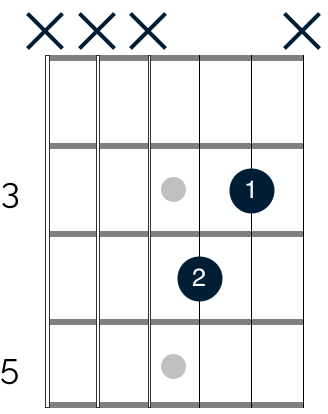
The 4th fret on the G string is the note of B — the major third of a G major triad or full G7 chord. The 3rd fret on the B string is the note of D, which is the fifth of the same two chords.
Vaughan slides into the notes shown above over the I chord (G7). In this way, he creates a strong connection between what he is playing and the harmony of the progression.
When the progression then moves to the IV chord (C7), Vaughan targets the exact same idea by playing the following double stop:
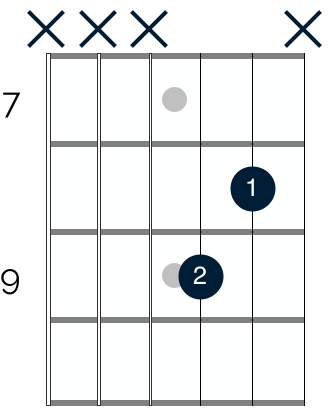
Here he has shifted the same shape up the fretboard to play the notes of E (on the G string) and G on the B string.
The E is the major third of the C major triad or C7, and the G is the fifth. So again Vaughan creates a connection between his lead part and the chords he is playing over.
The second example is the double stop that Vaughan targets in the turnaround:
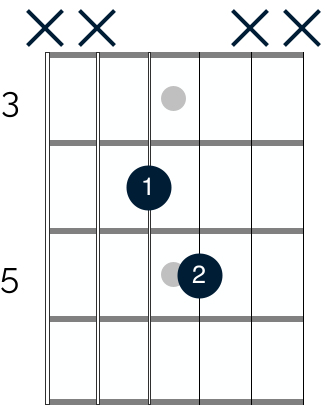
He plays this over the D7, before the chord progression loops back to the beginning.
This works because the 4th fret on the D string is the note of F# — the major third from the D7. The 5th fret on the G string is the note of C — the b7 from the D7.
So together the two notes spell out the D7 chord and create a strong pull back to the I chord and the beginning of the progression.
Vaughan adds a little bit more magic to the idea by a chromatic line targeting the 3rd, 4th and 5th frets on the A string before playing the chord.
It’s a classic Stevie Ray Vaughan move that you’ll hear a lot in his playing, and it is one that works very well and which you can easily shift into different keys.
This kind of chord tone targeting can really make your lead playing feel coherent and intentional. So try some of these ideas out and see how you get on!
Closing thoughts
The three ideas covered in this lesson are just some of the many that we could take from Texas Flood.
However if you consolidate each of them at a deep level, not only will you be able to effectively jam over the track, you’ll also develop skills you can apply in a wide range of blues contexts.
As you work on each of these points, don’t forget to add some of that Stevie Ray magic to your playing through your articulation.
You don’t need to play fast, but to sound like SRV you do need to play with intention — to dig in, add vibrato and focus on bringing every note to life through technique.
Good luck and have fun working on these concepts! And if you have any questions at all that I can help with, just post them below and I’m happy to help.
See you next time!
Feature Image – ©RTBusacca / MediaPunch (Taken from Alamy)




Responses