
If you’re looking for an Albert King guitar lesson that goes beyond a handful of licks, “I’ll Play the Blues for You” is the place to start.
It’s one of my favourite minor blues tracks – with an awesome groove, great singing and of course beautiful guitar playing. And more than that, it’s one of the most useful songs you can study to push both your rhythm and lead playing forward at the same time.
There is so much to learn from this song as blues guitarists.
In this lesson though, I want to focus on three things that will make an immediate difference to your playing.
The Minor Blues Form
As blues players we spend a lot of time moving between the same three dominant 7th chords. And if you spend most of your practice time here, it can be easy to get so locked into that pattern that anything different or more complex feels unfamiliar.
In the major blues, everything is built around dominant 7th chords – the I, IV and V.
The minor blues roughly maintains that same structure, as most minor blues songs also include the i, iv and v chords (indicated here by lowercase Romans, as they are minor chords, not major).
Generally speaking though, most minor blues songs will either include more chords beyond these three, or there will be a reordering of the chords.
This is usually because of the turnaround section of the 12 bar blues.
So much of the power of the 12 bar blues structure relies on the final few bars. The tension builds until it hits the final V chord, which creates a very strong harmonic pull that “turns you around” to the beginning of the progression.
When you play that final v chord as a minor chord, a lot of the harmonic pull is lost. It sounds fine, but you don’t get that same impactful chord shift that moves you from the V to the I chord, as you do when playing in a major blues.
Musicians find a variety of ways around this. However one of the most common mechanisms is to play the V chord as a dominant 7th or a major chord, even in a minor blues.
That single change restores the tension and harmonic pull that the turnaround needs.
So in the key of G minor, a “standard” minor blues might look something like this:
Gm | Gm | Gm | Gm
Cm | Cm | Gm | Gm
Dm | Cm | Gm | D7
So you’re playing minor chords throughout – Gm as the i chord, Cm as the iv chord and Dm as the v chord – right up until that final bar, where the V chord switches to a dominant 7th.
This creates that strong and satisfying pull back to the beginning of the chord progression, which is missing if that chord remains minor.
The “I’ll Play The Blues For You” Chord Progression
Many minor blues songs – including “I’ll Play The Blues For You” take this framework and makes it richer and more complex by adding extra chords into the mix.
The progression is a 14 bar blues that runs like this:
Gm | Gm | Gm | Gm
Cm | Cm | Gm | Gm
Bb | D7 | Cm | Cm
Gm | Gm
The first eight bars follow a fairly standard minor blues pattern. After that, you get a Bb major chord – the III chord – which you wouldn’t typically encounter in a minor blues progression. This is followed by the D7 as the V chord before the progression resolves.
There are of course a whole range of different chord voicings you could use to play this progression. However the voicings I like to use (and which I use throughout the lesson above) are as follows:
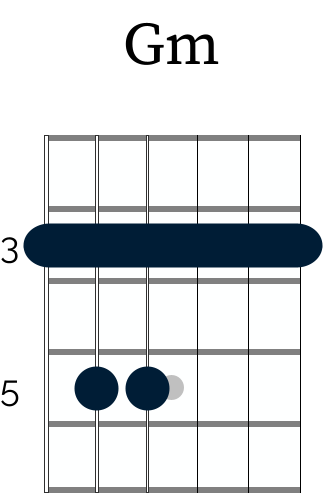
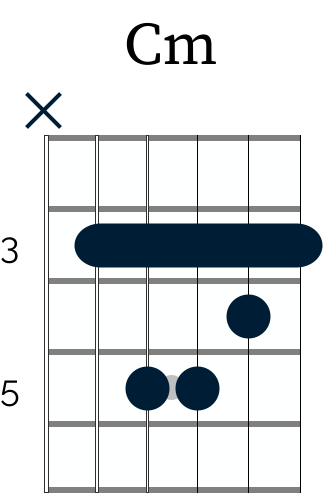
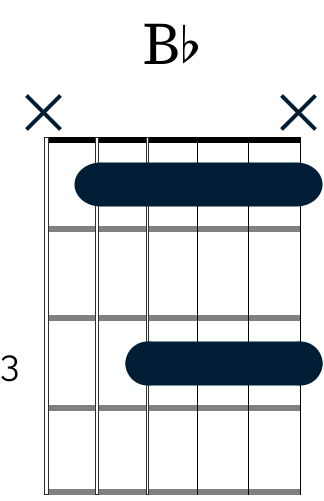
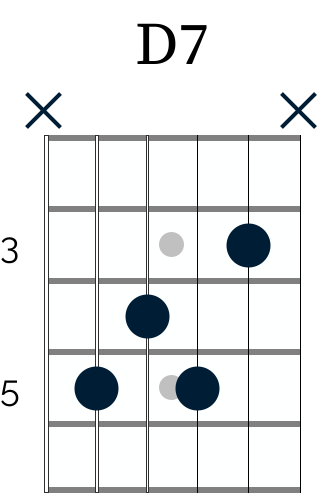
That major III chord is a beautiful addition in the progression. It’s a movement you don’t find in a standard major or minor 12 bar blues, and it opens up some interesting possibilities for your lead playing as you can target the notes of the chord and “play the change.”
It also helps you to build your ability to move through more complex chord progressions, which is an amazing skill to have, regardless of whether you’re jamming over a backing track by yourself or playing at a local jam night.
Syncopation and Articulation
“I’ll Play the Blues for You” is in straight 4/4 time, which means there are four beats per bar and the underlying pulse is even eighth notes:
1 & 2 & 3 & 4 &
One of the best ways of bringing a sense of groove to the playing is to focus on syncopation – emphasising the weaker beats in the bar rather than the strong ones.
In 4/4 time, beats one and three are the strong beats. Beats two and four are the backbeat, and the “ands” in between are weaker still.
When you target those weaker beats with your chord stabs, you create a groove that pushes the music forward without sitting squarely on the beat. You hear this constantly in funk, soul and slow minor blues and it helps to bring life and interest to the rhythm part.
For this progression, you can practice this syncopated rhythm on the Gm and Cm chords by playing short and sharp chord stabs on beats two and four, and playing nothing on beats one and three. So it looks something like this:
Rest – Chord Stab – Rest – Chord Stab
What makes this track a fun challenge as a player is that the approach you need to take changes as you move through the progression.
For example, when it moves to the Bb major chord, the part takes on quite a different feel. This means that the clipped chord stabs no longer sound quite right and you have to alter your approach – letting the chords ring out and breathe.
You can also arpeggiate these chords if you feel confident, which brings a very different feel to the progression and also builds your ability to coordinate your picking and fretting hands.
The Albert King Box
No conversation about Albert King’s guitar playing would be complete without talking about the Albert King box.
It defines his sound as a lead guitarist and is the quickest way of bringing a bit of that Albert King magic into your playing.
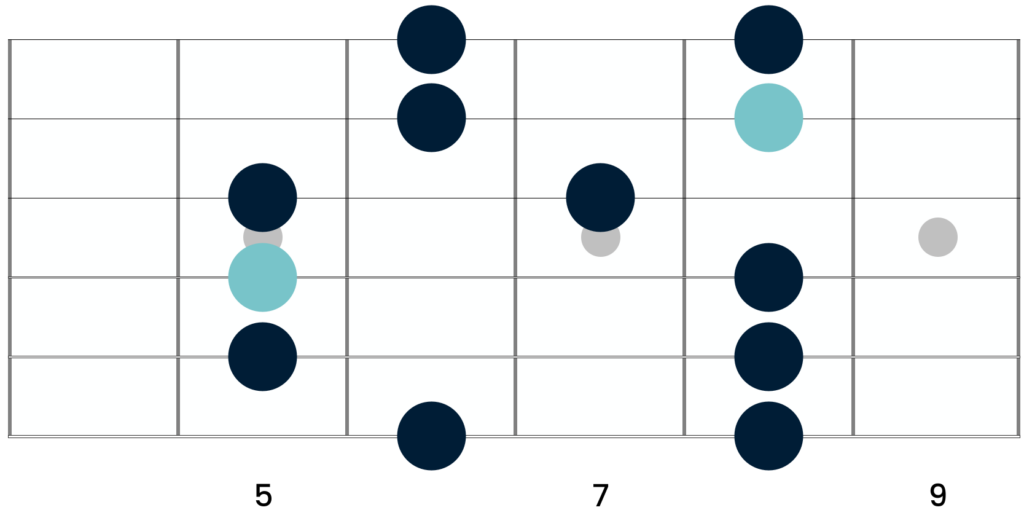
The box itself is very straightforward, and is in fact nothing more than the top five notes from the second shape of the minor pentatonic scale.
In the key of G which we are playing in here, the second shape of the minor pentatonic scale appears as follows:
And here is what the Albert King Box looks like in the same position:
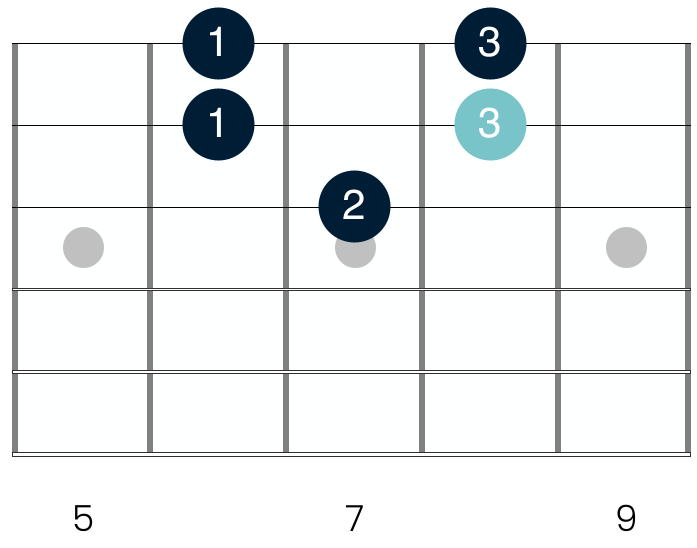
I’ve shown the fingerings I recommend to play the box, which allow you to navigate across it effectively and bend freely.
This second point is significant, as King managed to extract so much life from the box using bending. The tonic note – highlighted in blue on the diagram – and the 5th (played here at the 7th fret on the G string), are great points of resolution.
You can target the three remaining notes of the box with a huge variety of bends and stack them together to create vocal and expressive phrases with very few notes.
The key here is to use your first finger to play those bends on the left hand side of the box. In this way you don’t have to shift your hand back and forth and can hit all of the notes of the box in quick succession.
With only five notes to play around with, it can be easy to dismiss the potential of the box. However, there is so much to explore here that will help you bring the blues power and build your ability to get huge amounts of mileage from small note groupings.
If you’d like to dig a bit deeper into this then here you can find an Ultimate Guide on the Albert King Box, where I cover exactly how to approach it in more detail.
Targeting the Fifth
The final idea is a key part of what makes Albert King’s sound so distinctive, and it will immediately help you add some of that blues power magic to your phrasing.
Most of the time when I talk about resolving phrases, I focus on the tonic note. It’s the strongest point of resolution available and it brings any phrase to an effective close. The downside to targeting the tonic note is that it creates a very strong sense of finality that can also take some of the momentum out of your playing.
A beautiful alternative to this is to target the fifth instead.
Like the tonic it also creates a strong sense of resolution, but it lacks that same sense of finality. As such it doesn’t fully settle like the tonic, which helps to maintain some movement and forward momentum in your playing.
So instead of creating a lick that then feels like it comes to a complete stop, and then moving to the next lick and repeating the process, you can join ideas up in a way that feels more natural and fluid.
In the key of G, the fifth is D. Here is where it appears in the first shape of the minor pentatonic scale and the Albert King Box:
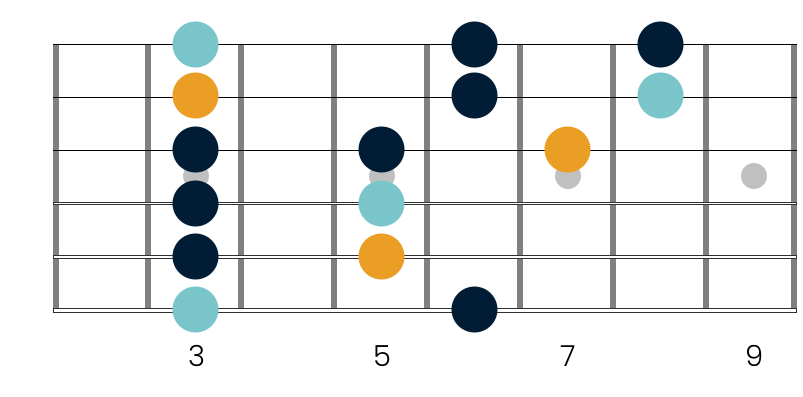
Highlighted in amber, you can hopefully see that the fifth sits directly beneath the tonic note – appearing on the same fret but one string lower (in pitch).
The only exception to this is between the G and the B string, where the fifth sits one fret lower than the tonic.
I appreciate that this might look a little overwhelming at first, but the great news is that the position in which the fifth appears in these scale shapes is exactly the same in different keys.
In this way, once you’ve gained confidence identifying where the fifth appears in the G minor pentatonic scale, you can easily shift it into the key of A, B and C etc.
To build this confidence, just start by trying to resolve some of your phrases on the fifth instead of the tonic. This will feel awkward at first but stick with it, as it will do so much to bring variety into your playing, as well as a bit of that Albert King magic.
Putting It All Together
With all of this in mind, I’d recommend bringing the rhythm and lead elements together into one continuous performance.
Start with the rhythm part and work through the full 14 bar progression using syncopated stabs on beats two and four on the Gm and Cm sections, then open up and let the Bb major, D7 and Cm breathe.
After that drop into a solo – using the Albert King box and the first shape of the minor pentatonic scale as your main focus. Stack the phrases with bends and vibrato, and experiment with resolving to the fifth rather than always landing on the tonic.
Once you’ve finished improvising, return to the rhythm part and drop back into the syncopated stabs without breaking the groove.
Do that cycle repeatedly until the transitions between rhythm and lead start to feel natural and fluid. The minor blues is particularly good for this kind of practice because the slower tempo and more open feel gives you a bit more time to make decisions.
You can think about when to drop into a lick, when to hold back, and when to let a phrase stretch across a bar before you pick the rhythm back up on the other side.
Good luck, and I hope you have a lot of fun bringing the blues power! 😁
Image – Albert King (Pictorial Press Ltd / Alamy Stock Photo)




Responses