
The turnaround is one of the most exciting moments in a 12 bar blues.
It’s that point where the tension builds and builds in the final bars and then boom – it loops you back to the top of the progression, ready to go again.
We can add even more excitement and interest to this part of the 12-bar blues by targeting specific turnarounds.
That is what this lesson is all about. We’re going to look at five classic blues guitar turnarounds in the open position, each with a different feel and a different level of complexity.
More importantly, we’re going to look at the theory behind how each one works. This means that you can move beyond these specific examples and start to create your own turnaround ideas that you can use in different keys and musical contexts.
If you’d like a broader overview of blues turnarounds before diving in, you can find that in my article here: 10 Blues Turnarounds for Guitar
Otherwise, let’s get into it!
The theory behind every blues turnaround
Before we look at the five specific ideas, it’s worth understanding how turnarounds “work,” because the underlying logic is more or less the same across all of them.
In the final two bars of a typical 12 bar blues, you playing the I chord and then the V chord. In the key of E, that V chord is the B7, one common voicing of which is as follows:
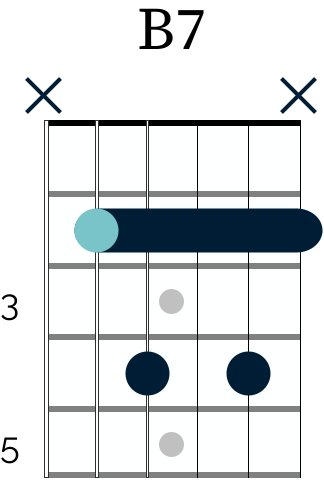
It’s that B7 which creates a strong pull back to the I chord at the top of the progression, and it’s this same harmonic movement that we are trying to recreate when playing a turnaround.
As such, most blues turnarounds work by playing an ascending or descending chromatic line that leads to one of three targets:
- Root note of the V chord
- The V chord itself
- Tonic note of the key before you jump to the V chord
In other words, you’re replicating that I to V movement in a way that builds tension and makes the return to the top feel inevitable.
In the key of E in the open position in which we’re playing in this lesson – E is the tonic note and B is the root note of the V chord. Here is where those notes appear across the fretboard in the open position:
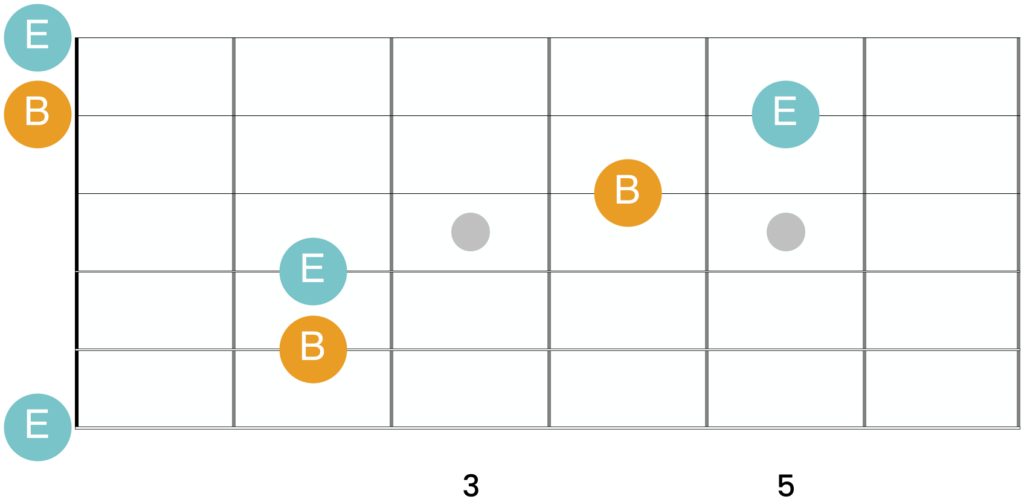
Keep this theory in mind as you work through these five ideas.
Once you understand what is happening in each of them, you can then start to reverse engineer them and create your own variations in any key or position.
And with that in mind, let’s get into them!
I – The walking bass line
This is the simplest of the five turnarounds and a great starting point for anyone new to blues turnarounds. A chromatic line ascends from the I chord up to the V chord with a swinging shuffle feel – clean, satisfying and highly transferable to other keys and contexts.
In the key of E, here is what it looks like:

And here is how it sounds:
Once you have it clean, make sure you’re swinging the rhythm of the single notes, so they have that bluesy bounce that matches the shuffle.
II – Hybrid picking
This one is more demanding, but it’s a great skill to develop because many of the other turnarounds in this lesson – and which you will. encounter in the blues in general – are built on the same idea. You’re playing pairs of notes on two different strings simultaneously, separated by a sixth interval, and alternating between the pick and a finger on the picking hand.
Here is one example in the key of E:

And here is how it sounds:
Synchronising the two hands is tricky at first, but take your time with it, as it will set you up for all of the further turnarounds in this lesson, and for many that you will encounter in famous blues tracks.
III – Pedal tones
This is the approach Robert Johnson uses at the start of “Sweet Home Chicago” and it’s a type of turnaround you will encounter all of the time in the blues.
It’s very similar to the hybrid picking turnaround, except now a sustained note is held on top while a chromatic line descends underneath it.
Here is the tab for the example that I play in the lesson:

And here is how it sounds:
From a theory perspective the sustained note is the tonic note of the key. So you are holding that tonic note while the lower line works down to B – the tonic note of the V chord.
In that specific example once I arrive to the note of B, I then play a chromatic chord of C7 before moving down to B7. The two voicings I use here are as follows:
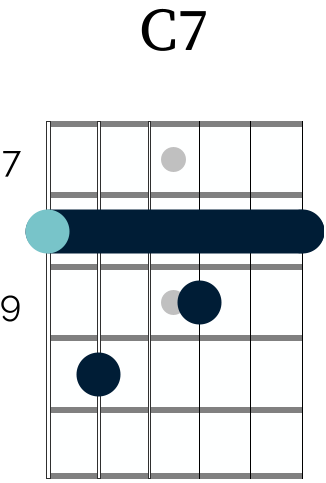
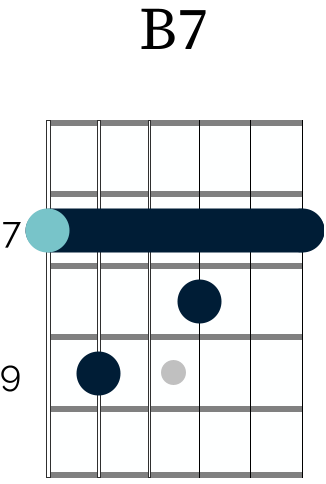
If you wanted to get down and back into the open position more quickly however, you could easily opt for voicings further down the fretboard too.
IV – Contrapuntal lines
A contrapuntal idea in music is one where two different lines move simultaneously in opposite directions.
So you have one line that is ascends in pitch and one that descends in pitch and you play them together. Here is the example that I play in the lesson:

And here is how it sounds:
The fingering here is challenging and it’s easy to get tangled up with the picking hand. But take your time with it as the pay off is a beautifully rich turnaround that sounds amazing, especially if you’re performing solo.
V – Lead turnaround
The final idea is one that you hear a lot in electric blues and in the playing of musicians like Stevie Ray Vaughan, Bonnie Raitt, Freddie King and Albert King, amongst others.
It involves dropping out of the rhythm part entirely and instead playing a lead lick. I illustrate a few different examples in the lesson, but the main one is as follows:

And here is how it sounds:
You have two ways to finish this idea – you can end on the note of B at the 2nd fret of the A string to create that same pull you get from the V to I chord, or you can walk up into either one of these B7 chord voicings:
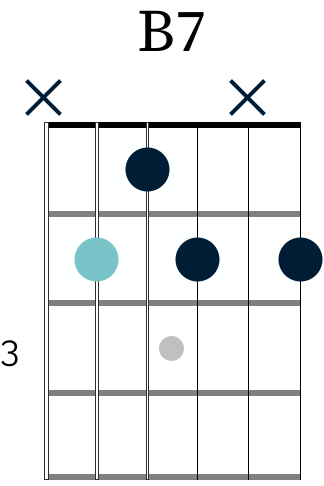
Both options sound great, so experiment and get comfortable with both, and you can then choose which option you’d like to go for in any given moment.
Closing thoughts
These five turnarounds are a great starting point to help you add some life and variety into your 12 bar blues progressions. However, the goal here isn’t to just memorise all five of these blues turnarounds note for note; it’s to use them as a starting framework that you can build on and make your own.
So once you’ve worked through these, try taking the underlying concept from each turnaround and apply it in a different key or position. Vary it, work to make it your own and you’ll soon have a bank of different turnaround ideas you can pull on whenever you’re playing.
Good luck, and have fun with it. If you have any questions at all, drop them in the comments below and I’m always happy to help.

Responses