
Adding licks between your chords is one of the most enjoyable things you can do as a blues rhythm guitarist, and it’s also one of the things that sets you apart as a player.
Rather than just holding down chords or just playing lead, you’re doing both at once: keeping the rhythm moving while adding blues licks in the spaces between.
There are two reasons this works so well:
The first of these is call and response, which is one of the fundamental principles of the blues. You hear it all of the time in the genre, both between instruments, and also between vocal lines and guitar lines.
Just think about how Stevie Ray Vaughan approaches “Texas Flood” (the backing track to which we’re jamming over here in standard tuning).
Vaughan sings a line and sets up the “call”, and then responds with his guitar. It sounds amazing and is a key part of slow blues tracks like this one.
The second reason this technique is so important, is that in a live context it allows you to make a meaningful contribution.
If you are playing in a busy line up with another guitarist or a keyboard player at a jam night, it can be difficult to find your space in the mix.
Adding licks between chords is a way around this and can help you make a significant difference to the overall vibe and feel of a track.
Getting started with this idea can be difficult at first. So in this lesson we’re going to look at three different approaches you can use to target it in your playing.
First things first though, let’s look briefly at the chord progression we’re playing over here.
Opening thoughts
In the video above I’m jamming over “Texas Flood” in standard tuning. This turns it into a pretty standard 12 bar blues, which runs as follows:
I IV I I
IV IV I I
V IV I/IV I/V
In each instance you see a “/” it indicates that multiple chords appear in a single bar. So in both bars eleven and twelve, you play two chords, rather than simply holding onto one chord as you would in a regular 12 bar progression.
So the main 12 bar includes a quick change, and the turnaround breaks into more rapid chord movements rather than the simpler V → IV → I → V pattern you’d typically encounter.
In the actual track there isn’t a lot of rhythm guitar. Stevie Ray Vaughan doesn’t play any chords and mostly just throws licks over a bass line that outlines all of the harmony.
However it’s because of this that it works so well as a template for slow blues playing. You have the drums and bass on the track bringing the groove, and you can work on your rhythm playing over the top.
The chord voicings that I use throughout the lesson are as follows:
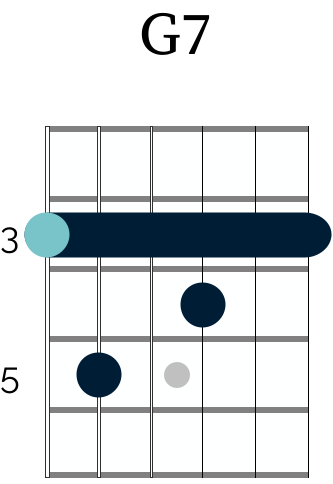
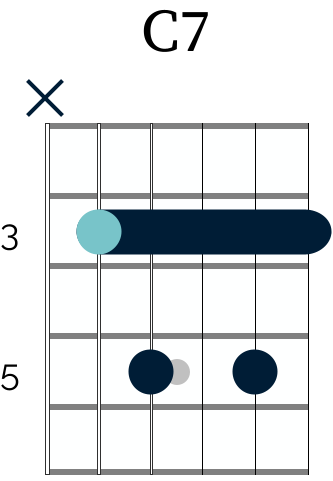
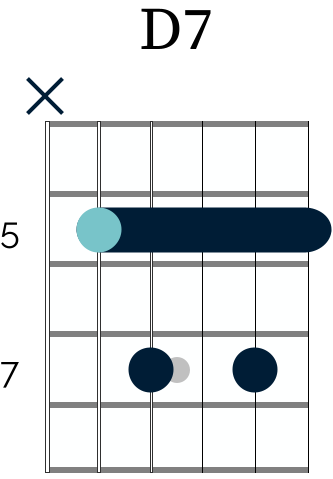
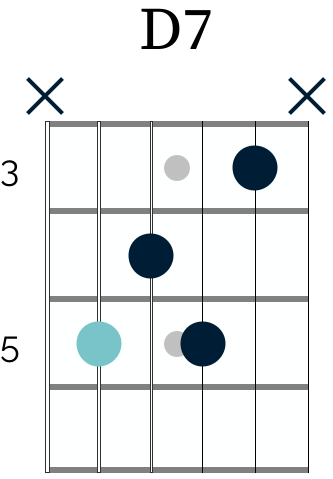
However you can (and should) mix things up, and also think about playing the C7 and D7 using these voicings:
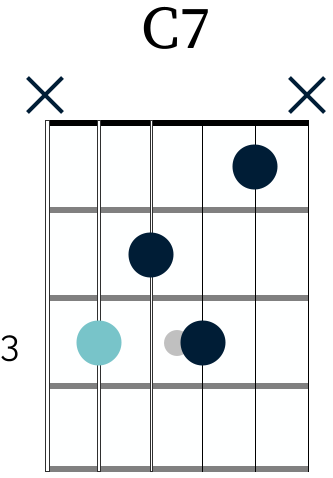
Now with those points covered, let’s look at three different ways we can bring these chords to life!
Approach I: Splitting the bar – Chord then lick
The simplest framework is to play chords on beats one and two and then drop into a lick for the second half of the bar. You start by outlining the chord, then you stretch out and add some lead lines before dropping back into the chords.
In terms of what to play for the lick, I would recommend staying close to the position you’re already in and using notes from the pentatonic shape that crosses over with the chord shape you’re playing.
For example, in the key of G which we are playing over, it would make sense to play notes from the first shape of the G minor pentatonic scale if you chose this chord voicing for G7:
Even though you are splitting the bar, you still haven’t got a lot of time to move between the chord and licks, and staying nearby makes things much more manageable.
Approach II: Playing the change – Walking into the next chord
In this second approach we push the lick right to the end of the bar — starting on beat four and playing through to the next bar.
Rather than a full lick, think of this more as two or three notes that walk you from one chord to the next, in the same way a bass player might walk between chord changes.
The practical benefit here is that you’re about to move to a new chord shape anyway, so breaking out of the current shape adds no extra technical burden.
You play your short phrase, and you arrive naturally at the new chord on beat one. It creates momentum through the changes and stops the progression from feeling static.
Approach III: Targeting the turnaround – The SRV move
The third approach is my personal favourite, and it’s very much a Stevie Ray Vaughan move that I’ve shamelessly “borrowed” (stolen! 😅) and included in my own playing.
Vaughan uses it a lot in his playing, though perhaps most famously in the song Texas Flood. I break that track down in more detail in this lesson here, so check it out if you want to learn more about how SRV plays over the song.
In the turnaround section (the final two bars of the 12 bar) — rather than playing chords throughout, you hit the I chord once as a stab and then drop into a longer lick that spans the rest of that bar and the whole of the final bar.
The key to making this work musically is targeting the V chord in the final phrase of the lick. This is because the V chord creates a very strong harmonic pull that “turns us around” to the start of the progression.
There are two ways I typically like to do this, both of which you can apply in any key in which you’re playing.
The first of these is to target the root note of the V chord.
In the key of G, you’ll find that here in the first minor pentatonic shape:
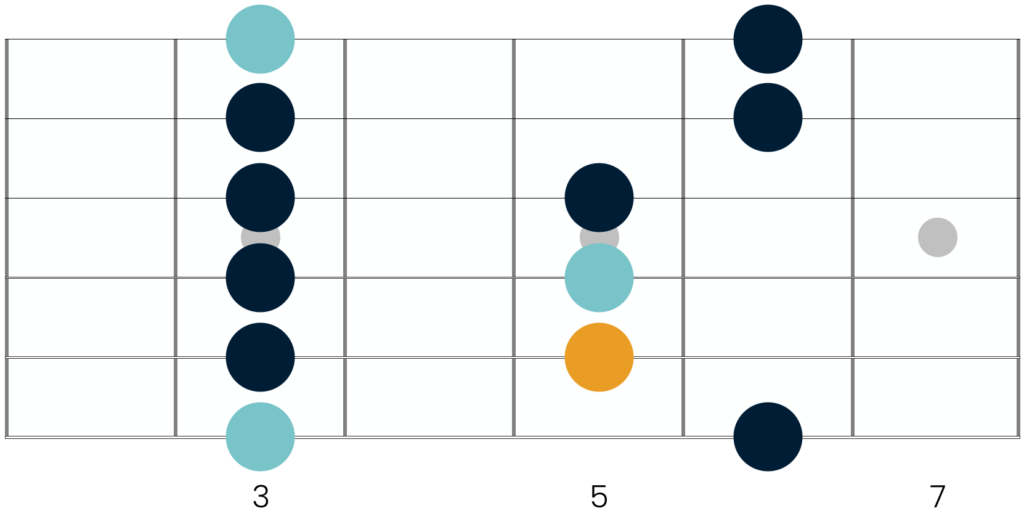
That note will always appear in the same position in the first minor pentatonic shape. So once you feel comfortable with this idea in the key of G, you can easily shift it into A or B etc.
You can also take this one step further by outlining the V chord (in this case, D7) by picking out additional notes from the chord.
In the key of G, you can pick out these two notes:
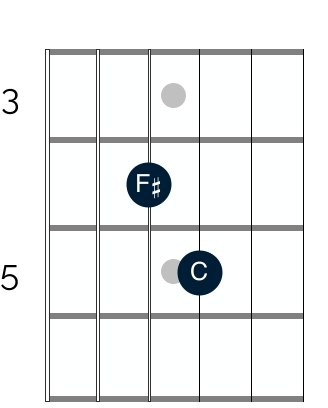
At first, it might be difficult to see how these notes relate to the V chord. However once we dig into things in a bit more detail, it becomes clear:
- The notes in a D7 chord are D F# A C
- The intervals in a D7 chord are 1 3 5 b7
So the F# gives us the major 3rd interval from the chord, and the C provides us with the b7. These are the only notes you need to spell out the V chord sound and create that strong pull back to the I chord.
If you want to add a bit of that SRV magic into the mix then you can walk up to that double stop by first playing the notes on the 3rd, 4th and 5th fret of the A string.
This is a classic Stevie Ray Vaughan move that you’ll hear a lot in his playing, and again, this is a moveable idea which you can easily shift into different keys.
Putting it all together
If these techniques are new to you, then I’d recommend trying to use them as much as possible at first.
This will help you build confidence quickly and help you to get to the point where mixing licks into your chords starts to feel more automatic.
Once you’ve reached that point, you can then begin to be a bit more selective about when you use it. Throwing licks into every bar quickly becomes repetitive, and might potentially have you clashing with other musicians if you’re playing live.
My own approach is to choose tactical moments in the progression: a short lick in bar four as the IV chord approaches, perhaps a longer lead idea in the turnaround, and one or two other places where the music calls for a bit more energy.
Start by overdoing it in practice and then gradually pull it back to something that feels natural and musical.
Good luck!
Have fun with this, and if you have any questions, please drop them in the comments and I’m always around and happy to help.


Responses