
“Help the Poor” is one of those blues tracks that rewards you every time you come back to it. It’s a rich minor blues with a distinctive chord progression, beautiful call and response between two blues legends, and a masterclass in how to make lead guitar feel intentional and connected to the harmony underneath it.
The song was originally written and recorded by Junior Parker in 1953, but the version most blues guitarists know is BB King’s – and there are actually two notable King recordings worth knowing about.
The first is BB King’s own studio version from the early 1970s, a classic slow minor blues that illustrates everything that makes his playing so distinctive.
The second – and the one we’re working from here – is the version he recorded with Eric Clapton on the Riding with the King album, released in 2000. The record brought together two of the greatest blues guitarists of all time, and “Help the Poor” is one of the highlights. It has unbelievable groove and soul, and some of the tastiest rhythm playing and lead licks you’ll hear in a minor blues context.
There’s a lot to take from this track. Here we’re going to focus on four things: the chord progression, triads, syncopation, and targeting chord tones over the changes.
I – The Chord Progression
Like many minor blues songs, “Help the Poor” moves beyond the standard I, IV, V progression that we encounter so often in a major blues.
The track is built around a 16-bar progression, which runs as follows:
Dm | Dm | Dm | Dm
Dm | Dm | A7 | A7
Dm | Dm | Gm | Gm
Dm | A7 | Dm | Dm
So Dm is the i chord, A7 is the V chord, and Gm is the iv chord.
The progression is heavily weighted toward the Dm chord and actually just sits on that single chord for six bars before anything else happens.
This is worth noting, because when the change to A7 does arrive, it carries a lot of harmonic weight. It’s a key movement in the progression and one that you can outline in your lead playing to highlight the chord change.
We’ll look at that in more detail in a moment.
For now, just work on getting comfortable with the overall shape of the progression. It’s quite different from the 12-bar forms most blues guitarists start with, and it takes a bit of time to internalise.
II – Triads
On the Riding with the King recording there are multiple guitar parts in the mix, with riffs, lead lines, and chords all weaving together.
Of these, the one that I think is most instructive for blues guitarists is the one laying down syncopated chord stabs using compact triad shapes.
Rather than playing full barre chords, which can sound heavy and cluttered in some contexts – King uses tight triad voicings for the D minor, A7, and G minor chords:
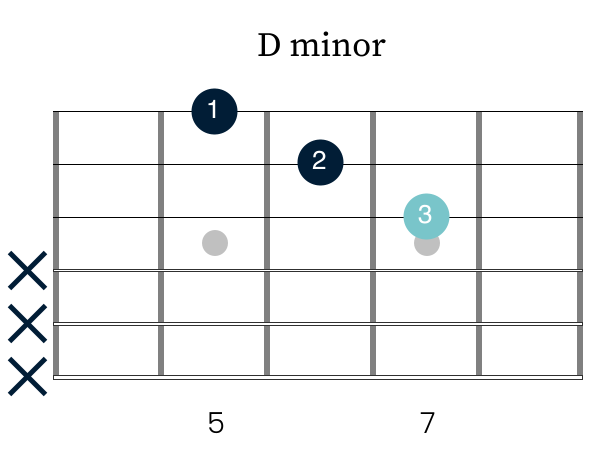
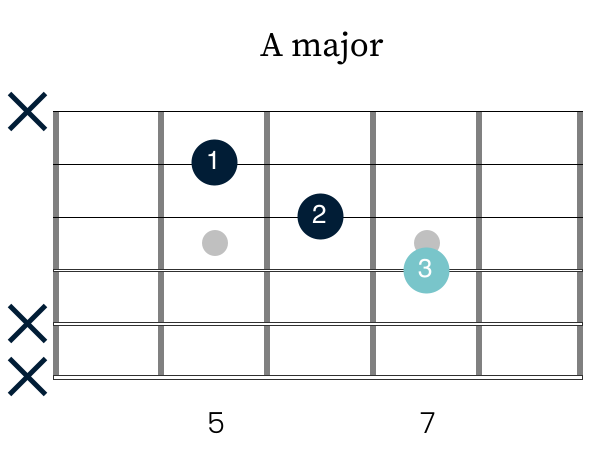
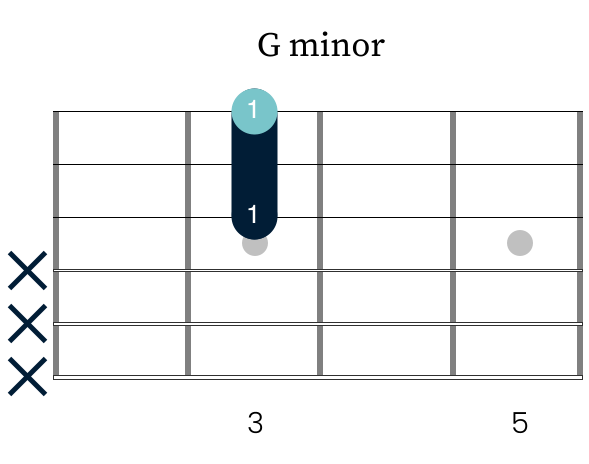
You can also add the root note in on the D string for the G minor triad to play it like this:
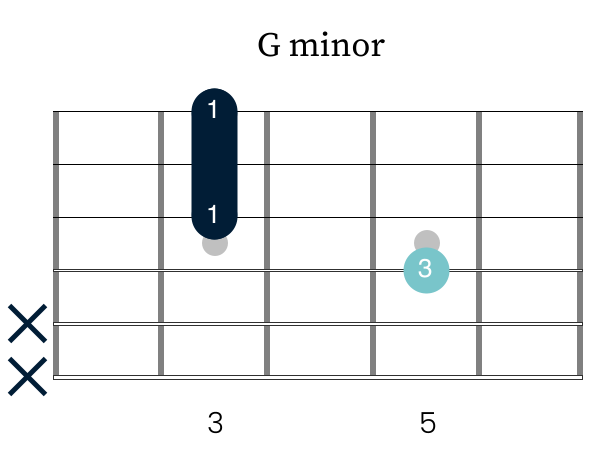
This voicing moves it beyond the strict triad shape, but it means you’re also building the chord from the root note on the D string, which is easier to track when you’re moving through the progression or playing the changes when soloing.
There are a couple of important points about these triads that are worth keeping in mind:
The first of these is that the shapes shown above are just some of the various different options available. These particular voicings work well because they sit right next to one another and also have a slightly more treble-focused sound that sits cleanly in the mix with other instruments.
However you should experiment with them all over the fretboard and across different string sets to build your confidence and understand what works best for you.
As you do so, just think about choosing voicings that sit very close to one another. This will help you move between them more quickly when playing rhythm and lead, and create very smooth-sounding chord changes.
The second point relates directly to the A7 chord. When we turn this into a three note triad, we are actually getting rid of the b7 from the dominant chord, and turning it into an A major triad.
This isn’t an issue though, as the A major chord performs the same function in the progression as the A7. In this way you can play an A major in the progression instead of an A7 and it will sound great.
The major triad also contains three of the four notes from the A7 chord, so by locking onto any of those over the change in your lead playing, you’ll effectively outline the movement from the Dm to A7 chord.
III – Syncopation
“Help The Poor” is in straight 4/4 time, which means there are four beats per bar and the underlying pulse is even eighth notes:
1 & 2 & 3 & 4 &
One of the best ways of bringing a sense of groove to the playing is to focus on syncopation – emphasising the weaker beats in the bar rather than the strong ones.
In 4/4 time, beats one and three are the strong beats. Beats two and four are the backbeat, and the “ands” in between are weaker still.
When you target those weaker beats with your chord stabs, you create a groove that pushes the music forward without sitting squarely on the beat. You hear this constantly in funk, soul and slow minor blues and it helps to bring life and interest to the rhythm part.
Often we encounter syncopation with rhythm parts that focus on beats 2 and 4. This works really well but is also quite easy to track, as there is a certain symmetry in each bar.
The approach here is slightly more advanced, as B.B. King places the first stab on the two, but then pushes the second stab to the “and” just before the four rather than landing squarely on the four itself. So you end up playing the following:
One – and – two – and – three – and – four – and
That small rhythmic displacement gives the bar a forward-pushing, slightly urgent feel that takes a little getting used to at first.
The best way to get this under your fingers is to start with the simpler two and four syncopation that you might already have encountered and get that feeling completely locked in before then gradually pushing that second stab earlier.
So you switch from landing on the four to landing on the “and” before it. The difference between the two is subtle, so use a metronome to provide a steady pulse you can measure against to feel exactly where the shift happens.
It is tricky at first, but once it clicks, it’s a very satisfying rhythm to play. It has a groove that the more symmetrical two and four pattern doesn’t quite capture, and it will do a lot to sharpen your ability to place rhythmic ideas consciously and precisely.
IV – Targeting chord tones
B.B. King’s lead playing is so often talked about in terms of feel, space and vibrato – and all of that is absolutely true here.
But there’s something more specific and more instructive happening in this song that’s worth looking at in a bit more detail.
Because so much of the progression sits on that D minor chord, when the A7 finally arrives after six bars it creates a powerful opportunity to play the change. The harmonic shift is so clearly defined that targeting the notes of that A major chord right at the moment it lands immediately makes the lead playing sound more intentional and more connected to the harmony underneath it.
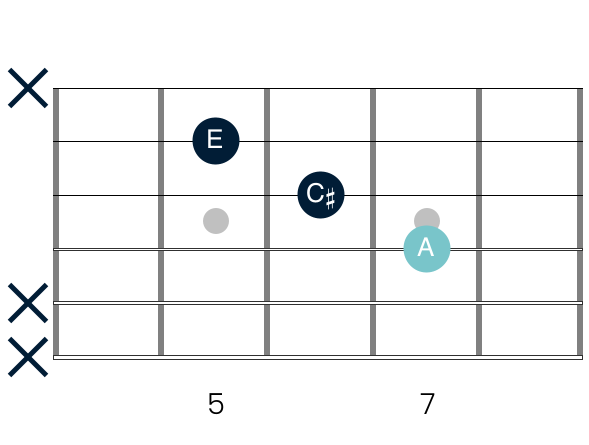
What King does is focus on two notes from the A major triad in particular: the E (the fifth of the chord) and the C# (the major third).
Here is where those notes appear in the triad shape illustrated above:
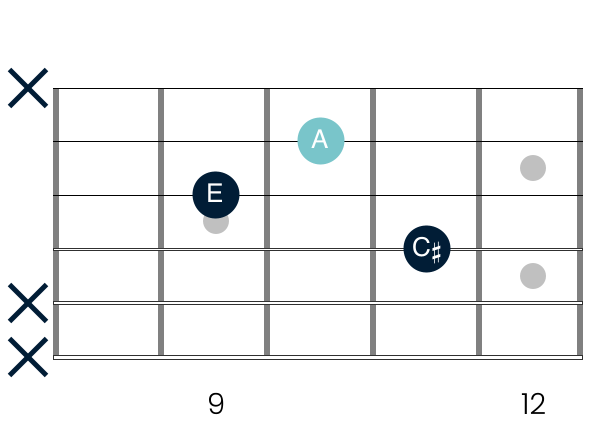
It’s also useful to look at the first inversion of the same A major triad shape. This is because it crosses over with the first shape of the D minor pentatonic scale – which is likely to be a position you’ll use frequently when soloing:
In fact, we can take that one step further and look at where the two notes that King targets from the A major triad sit across the first shape of the D minor pentatonic scale:
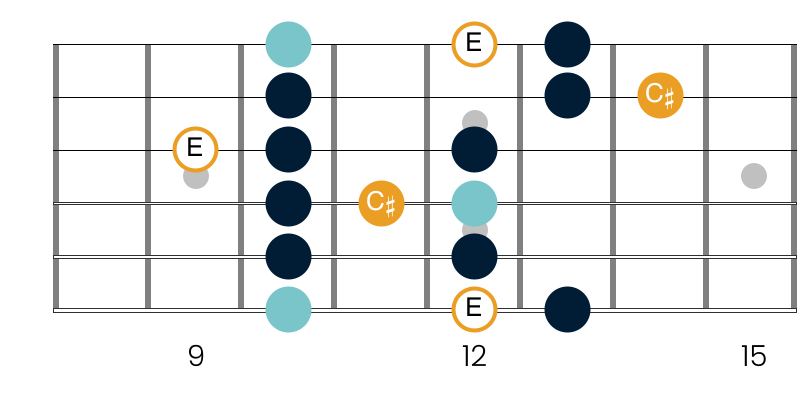
In this way, you can base your solo out of a familiar scale pattern, and from there dip out to grab one of the more flavourful notes from the A major chord.
The E is the safer option here, so I’d recommend starting out with this note. This is because over the D minor chord, the note of E functions as the major second. It sits just two frets above the root and has a bright, open quality that works well in a minor context without creating any harsh clashes.
Then as the A major chord arrives, that same E becomes the fifth of the chord and takes on a different colour. In this way the “risk” of outlining the change is lower, as you won’t create any harsh clashes or very tense sounds if you don’t quite land it right.
This isn’t true over the C#. This has a much stronger flavour, which is partly why it works so well over the change. However if you hold that note over the D minor chord, it will create a tense sound that is likely to disrupt the vibe of your solo.
As such, I’d recommend targeting this note over the change once you feel comfortable getting to the E over the A7/A major chord.
And regardless of which note you choose, use technique to bring these ideas to life. Slide into the notes, use hammer ons and pull offs, and if you feel confident to do so, bend up into the notes. This has a beautiful sound and it’s exactly what King does throughout the track.
Remember also that you don’t need to be constantly chasing chord tones throughout the solo. This can quickly become boring and predictable, and move you away from a more traditional blues sound. It’s also not the approach that most blues guitarists take when playing.
Throughout the track B.B. King spends the majority of his time in familiar minor pentatonic territory. Then at key moments – and particularly when the A major chord arrives after all that time on the D minor – he reaches out and grabs one of those chord tones to mark the change. That intentionality is what makes the solo feel melodically sophisticated without ever straying too far a more classically bluesy sound.
Closing thoughts
And there we have it – four of the key concepts that we can take away from this beautiful blues track.
Take these ideas one by one and practice them over a backing track by going through the following steps:
- Learn the chord progression using the triad shapes illustrated above. Don’t worry about your rhythm for now and instead just get comfortable with the order of the chords and the triad shapes
- Once you can confidently play through the chord progression, bring in the syncopated rhythm. Start by targeting beats 2 and 4, and from there switch to target the two and the “and” before the 4
- Move from rhythm to lead, jamming over the track using the D minor pentatonic scale
- Once you have the feel and groove of the track under your fingers, start tracking the changes and trying to get to one of the notes from the A major chord
Good luck, have fun – and keep me posted in the comments with how you get on! 😁



Responses