
As blues players, when it comes to soloing, we typically play over dominant 7th chords or minor chord progressions — and in those contexts, the minor pentatonic scale is our natural home.
There are situations though where that approach doesn’t work, and it’s worth knowing what to do when you find yourself in one.
This comes up a lot in what I call “blues-adjacent music” — songs like “Wonderful Tonight” by Eric Clapton or “Gravity” by John Mayer.
These are not blues songs, and their structure is normally very different to what we’ll play over in a classic blues context. However the lead guitar playing has a bluesy feel to it, and that is what we want to recreate when the moment comes.
That’s what this lesson is all about – how to handle this situation and solo effectively when you are playing over major chord progressions.
So with that in mind, let’s get into it!
What not to do
Before we look at the right approach to take, it’s worth highlighting what not to do — and that’s to reach for the minor pentatonic scale.
This is because there will be a clash between the major 3rd in the chord you’re playing over, and the minor 3rd in the minor pentatonic scale.
If you try and solo with this approach you’ll have a “hit or miss” experience in which some notes and phrases work, and others sound slightly tense and dissonant.
So what do you do instead? There are three approaches worth knowing.
Approach I: The major pentatonic
The simplest and most reliable starting point is the major pentatonic scale of the key you’re playing in.
The track that I’m playing in throughout this lesson is “Wonderful Tonight” by Eric Clapton, in the key of G.
In that context then, the G major pentatonic would be your starting point.
There are no clashes between the chord and the scale, all of the notes of the scale fit naturally over the progression, and it immediately gives you the brighter, more open sound that a diatonic major progression calls for.
Here is what the five shapes of the G major pentatonic scale look like:
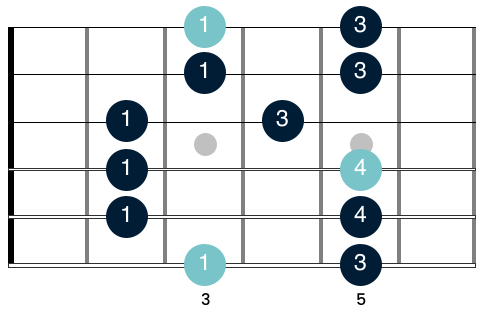
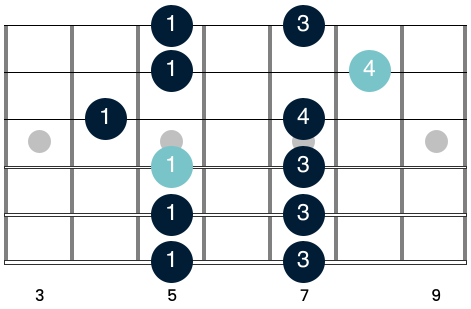
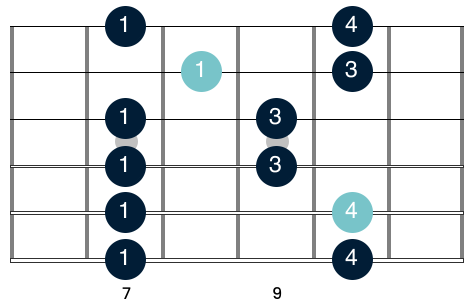
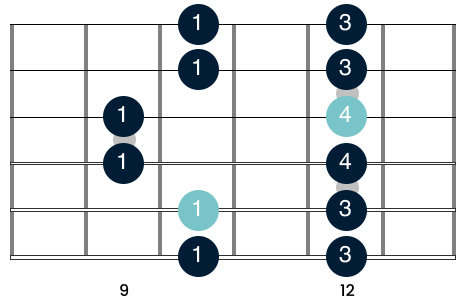
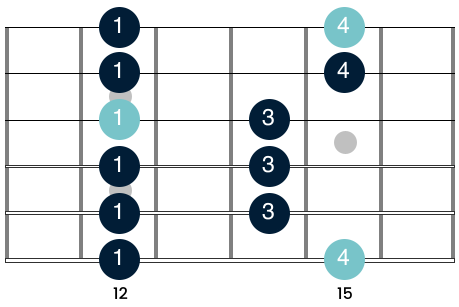
My suggested fingerings are shown, and the tonic notes (in this case of G) are highlighted in light blue.
If you’re new to the major pentatonic or haven’t spent much time with it, this is a great place to start.
Get the scale shapes under your fingers and spend some time improvising with it over a G major backing track, like “Wonderful Tonight” or “Gravity.”
Approach II: The relative minor pentatonic
For many blues players, the positions and patterns of movement in the minor pentatonic scale are so engrained that it can be tricky to make a switch to the major pentatonic scale.
If this is the case, then you can instead think about targeting the relative minor.
This is almost more of a mental hack or framework than anything else, but it can be very useful when playing over major chord progressions.
Let me explain in a bit more detail.
Every major key has a relative minor that shares exactly the same notes, and you’ll find this by going to the 6th degree of the major scale.
In G major, the notes are as follows:
G A B C D E F#
The 6th degree of the scale is E, making E minor is the relative minor of G major. The notes in E minor are as follows:
E F# G A B C D
As you can see, the notes of the scale are identical.
And this extends to the pentatonic scales that are contained within these broader major and minor scales. This is clear when you compare the shapes of the G major and E minor pentatonic scales:
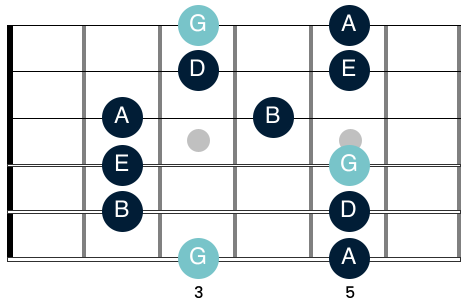
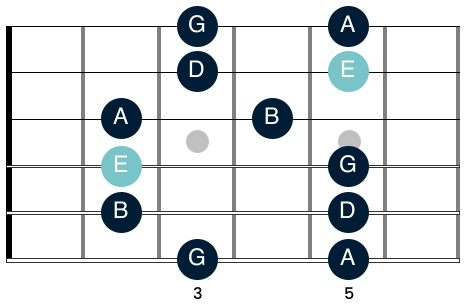
Both scales contain the exact same notes, the only difference is where the tonic notes appear in each scale.
This means that if you think “E minor pentatonic” while playing over a G major progression, you’re actually playing G major pentatonic.
The notes of the scale are the same, which means that you can think and follow more familiar minor pentatonic patterns whilst soloing effectively over a major progression.
The only noticeable difference is that if you are thinking in E minor you might be inclined to resolve your phrases to the notes of E rather than G.
This isn’t a real problem, but as you build confidence with this approach try to be conscious of where the notes of G are and use them as points of resolution.
As a final point here, it is worth noting that this relative minor/major relationship exists between all major and minor keys.
For example, the notes in C major are as follows:
C D E F G A B
The 6th degree of the scale is A, meaning that A minor is the relative minor of C major.
As above, this also applies to the pentatonic scales within the broader major and minor scales. So the C major and A minor pentatonic scale shapes are the same, and you can think about using the A minor pentatonic scale when soloing over a C major chord progression.
A great example of this approach is George Harrison’s solo in the Beatles’ song “Let It Be.” The song is in C major and Harrison plays quite classic A minor pentatonic based licks throughout, all of which work perfectly over the progression.
Approach III: Targeting chord tones
Once you have a solid foundation with either of the above approaches, you can start thinking about targeting chord tones, which will give your lead playing a very melodic feel.
There are a variety of different methods and frameworks of approaching this, but to begin with I would recommend simply choosing chord voicings in the area of the neck where you’re soloing, and using them as a reference.
If we stick with “Wonderful Tonight” for example, you might choose these three voicings of G, D and C:
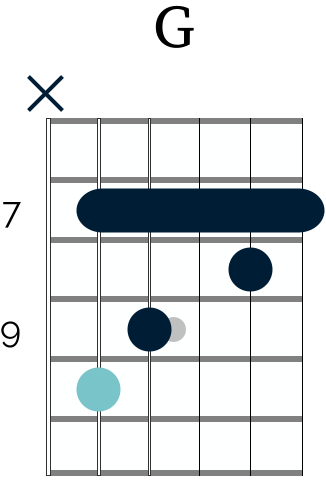
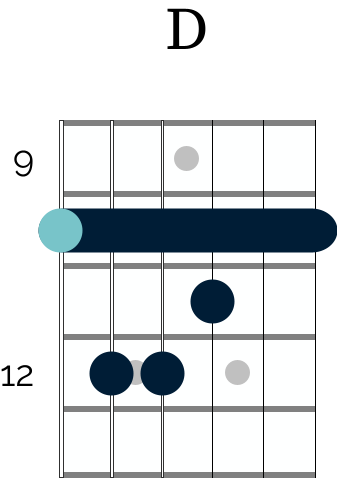
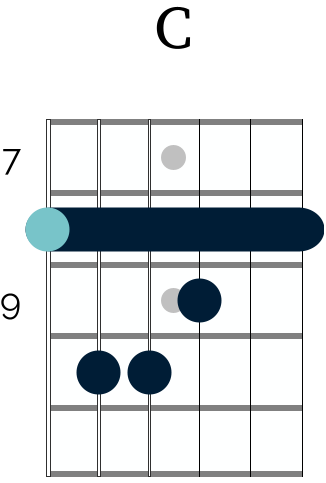
In this way, you can solo and craft lead ideas in the same position that Eric Clapton does in the track, and target notes from each chord as they roll around.
You don’t need to track every chord change, as doing so will make your playing sound stiff and predictable.
However you can look at how these chords cross over with the G major / E minor pentatonic scales and from there dip out and grab notes from the chords in key moments.
For example, when the chord of D arrives, you could target the F#:
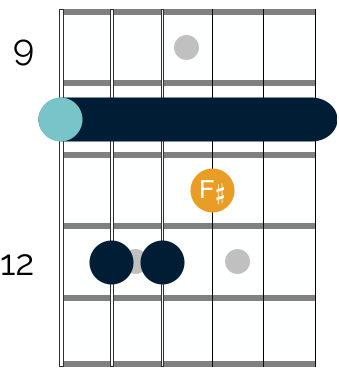
This is the major third of D, and a note which doesn’t appear in the G major pentatonic. As such, targeting it in your solos will both help you spell out the chord change and also bring a new flavour into the mix.
The same is true of targeting the note of C over the C chord:
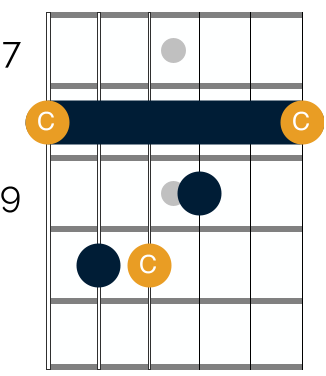
These are just a couple of examples using two chord shapes. However you can apply this concept all over the fretboard and to any of the notes within each of these chords.
Used sparingly, and when combined with bluesy techniques like sliding and bending, this approach can give your solos a vocal and melodic quality and create a strong connection to the harmony you’re playing over.
Closing thoughts
If you’re primarily a blues guitarist, major progressions like “Wonderful Tonight” aren’t going to be anywhere near as common as 12-bar blues progressions or shuffles. And this is partly what makes them such a valuable thing to spend your practice time on.
Learning how to effectively improvise over a major progression pushes you to do things that will make you a better guitarist across the board:
You’ll move beyond the minor pentatonic scale, develop confidence targeting chord tones, and have the challenge of creating an authentically bluesy feel in a different musical context. And all of that will feed directly back into your blues playing in a positive way.
Good luck, and please keep me posted in the comments with how you get on, or if you have any questions!
Image – Alamy




Responses