
“Damn Right I’ve Got the Blues” is an amazing example of a high energy blues track that brings the blues power.
There’s a driving riff, aggressive and intense lead playing, and a relentless energy that drives the track from start to finish.
There is so much that we can take from this song and apply in our own playing.
In this lesson we’re going to break the track down and focus on three of the main concepts that will push both your rhythm and lead playing to the next level.
Let’s get into it!
I – Building blues riffs like Buddy Guy
The whole song is built on a swinging, funky riff that creates a lot of energy and drives the track forward.
Riffs appear all of the time in the blues, but this one is so effective because Buddy Guy mixes up the rhythm he uses and adds technique into the mix.
For example, this kind of riff is one that you may have encountered many times before:

At 110 BPM, it sounds like this:
I’m a little bit harsh on this riff in the video, but played with swung eighth notes, it also has a cool bluesy feel (it was after all the riff that Freddie King used in the amazing blues track “I’m Tore Down“).
However, by mixing up the rhythms used to move across the pattern, we can create a riff that is less symmetrical and as a result less predictable and a bit more playful.
You can hear this if we mix up the rhythm and hold some of the notes for twice as long as in the first example:

At the same tempo, this sounds like this:
And if we push that further and mix up which notes we hold for longer, we can bring an even greater level of interest to the playing.
This is particularly the case if we add some technique into the mix and use vibrato, bends and little blues curls to add life to the notes, just as Buddy Guy does in the track.
Here is a slightly longer example that brings each of those different elements together:

And at 110 BPM it sounds like this:
There is more variation in these four bars than you might add in a real playing context.
However hopefully it illustrates how you can start with a simple idea and turn it into something more engaging and interesting by following these steps.
To get comfortable with this idea, I’d recommend starting by varying the rhythm.
Once you can move through a whole 12 bar blues and track your riff across the progression, you can then start to focus on technique to bring the playing to life.
II – Creating pentatonic connections across the fretboard
One of the most common frustrations for late beginner and early intermediate guitarists is that they get stuck in the first pentatonic shape.
I can totally understand why. It’s comfortable, it works well, and you can create a huge range of ideas from it.
However there will come a time when you want to move freely all over the fretboard and break out of that pattern. And this track is a great example of how to do that.
Throughout the song, Buddy Guy flies all over the fretboard, making big jumps between positions and connecting pentatonic shapes in different ways.
There is a lot going on here, but there are two key ideas that I think are worth focusing on.
The first of these is the way in which he connects the top half of the second pentatonic shape (the Albert King Box), with the first pentatonic box shape.
Specifically, he uses the G string as a thread to move both up and down between the two positions:
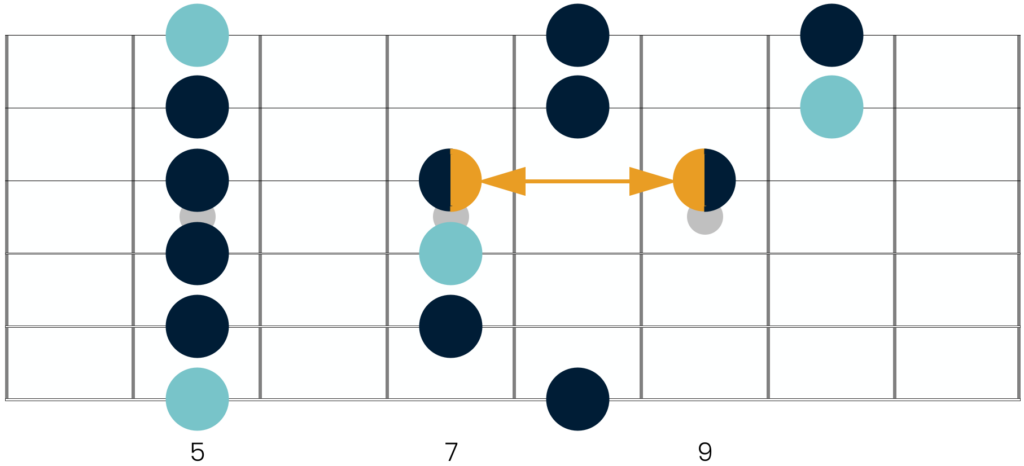
The tonic notes of A are highlighted here in light blue, with the notes used to connect the two positions highlighted in amber.
Buddy Guy then actually extends this idea to cover the whole fretboard.
This is a topic that I cover in much more detail in this lesson here. As such, I won’t repeat that content in depth in this lesson.
In short though, the approach is quite simple. You lay out the notes of the minor pentatonic scale you are using across the G string and use that as a thread to navigate up and down the neck.
From there you then target the notes from each minor pentatonic box that appear on the G, B and E strings.
If we do this in the key of A, we end up with the following:
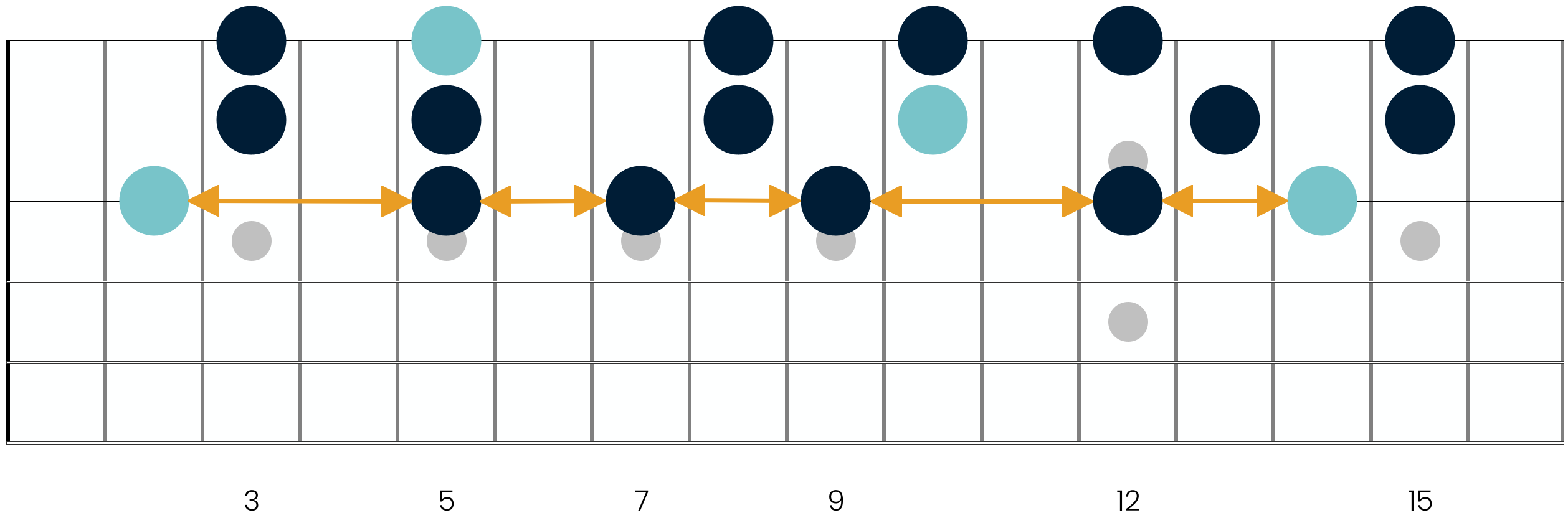
This provides you with a very effective framework for navigating across the fretboard when you are soloing.
To begin with, think about moving stepwise through the shapes, so you are always connecting adjacent shapes.
As you start to feel more confident, you can then add a bit of that Buddy Guy magic into the mix by making bigger jumps.
Those large movements create instant intensity and excitement, and are a brilliant way to push the energy of your solos up to the next level.
III – High octane blues phrasing
The final thing that we can learn from Guy is his approach to phrasing.
So often I talk about and recommend a “less is more” approach that involves greater restraint and more focus on the quality of each note.
However there will always be those moments when it sounds amazing if you dig in, play a lot of notes and just bring the blues power.
This is exactly what Buddy Guy does, making his phrases sing in the following three different ways:
I – Big jumps up and down the neck
As noted above, Guy jumps up and down the fretboard, which is a brilliant way of adding intensity into your solos.
Practice this by following the thread across the G string, but have fun experimenting connecting pentatonic shapes in different sections of the neck.
II – Licks that end nowhere
Rather than always punctuating his phrases with a clean resolution, Guy often just cuts his licks off mid-air.
This creates quite an abrupt sound, but in a very cool and bluesy way, and it’s often used in more intense blues contexts like this one.
For example, Stevie Ray Vaughan does the exact same thing in the first solo in the song “Tightrope“.
The technique here is quite simple. When you are playing, use your fretting or picking hand (or a mixture of both) to mute and cut the note short, right where the listener expects the phrase to continue.
It works best on slightly faster phrases (all of the examples I use above are part of faster phrases with a lot of pull offs), so start with similar ideas.
From there, experiment with different licks and phrases to see what works best.
III – Intentional repetition
As guitarists I think we are often afraid of repetition. We have this idea that playing the same note more than once immediately exposes us as not having a robust musical vocabulary.
However repetition can be a wonderful tool when used in your solos, either to create a motif and bring a sense of structure to a solo, or to build tension and energy.
Buddy Guy creates the latter throughout his solo by hitting the same note three or even four times in a row.
Done without intention, this can become filler – the guitar equivalent of saying “um” and “er” a lot when you are speaking. But when you target this idea and hit those notes with commitment, it builds tension in a very effective way and drives the solo forwards.
If you’re used to taking a more restrained approach in your solos, give this a go and see how it impacts the overall feel of your improvisations.
A final note on scale choice
As a final point, it’s worth noting that throughout this track, Buddy Guy sticks almost entirely to the minor pentatonic scale.
This is true even though he could also use the major pentatonic over the progression. Yet he doesn’t, because he wants to add the aggression and intensity of the minor pentatonic scale.
So even though the major pentatonic would work from a theoretical point of view, it would also soften the sound of the playing and take some of the edge away from his lead lines.
Appreciating these nuances is important, especially as you develop as a player.
Once you learn more scales and your vocabulary increases, it can become easy to dismiss the minor pentatonic as something to move beyond as quickly as possible.
Yet throughout “Damn Right I’ve Got the Blues”, Guy reminds us that there is a huge amount of gold to be found in the minor pentatonic when you play it with conviction, expression and intention.
So play it loud and play it proud!
Have fun jamming and practicing over the track, and if you have any questions, drop them in the comments below and I’m always around to help 😁
Image – Wikimedia Commons





Responses