
When most people think about great guitar performances on While My Guitar Gently Weeps, there is one that immediately comes to mind:
Prince’s three-minute solo at the 2004 Rock and Roll Hall of Fame induction ceremony — performed alongside Steve Winwood, Tom Petty, Jeff Lynne and Dhani Harrison — is the stuff of legend.
The on-stage theatrics, the face-melting playing, and the surprise for many of seeing a musician they had Prince reveal himself as a genuine guitar great: it is one of the most iconic live guitar moments ever captured on film.
But there is another version of this song that has stayed with me ever since I first heard it as a teenager. One that I think is significantly underrated, and one that has a huge amount to teach us as blues guitar players.
That version is Jeff Healey’s recording from his 1990 album Hell To Pay. It features unbelievable playing, extraordinary singing, and — perhaps most compellingly — it has the seal of approval of George Harrison himself, who played rhythm acoustic guitar on the track and contributed to the vocal harmonies.
In this lesson and article I am going to break down the key blues guitar concepts and techniques that Healey uses throughout this recording.
These are ideas that you can apply not just when jamming over this track — which, incidentally, is one of the most enjoyable things you can do on the guitar — but in any blues or rock soloing context.
In this article I will cover:
• Adding colour to your playing with the major second
• Bending techniques: the root note bend and the pinky grab
• Using slides to navigate the fretboard with fluidity
• Building speed and punch with legato runs
Let’s get into it!
Adding colour with the major second
The foundation of Healey’s lead playing in the track is the A minor pentatonic scale, which is what gives his playing its bluesy flavour.
However, there is one additional note that he targets repeatedly — both in the opening solo and in the main solo — that significantly alters the flavour of his phrases.
That note is the major second, or the ninth when voiced an octave higher. In the key of A, this is the note of B, and it appears here in the first position of the minor pentatonic scale:
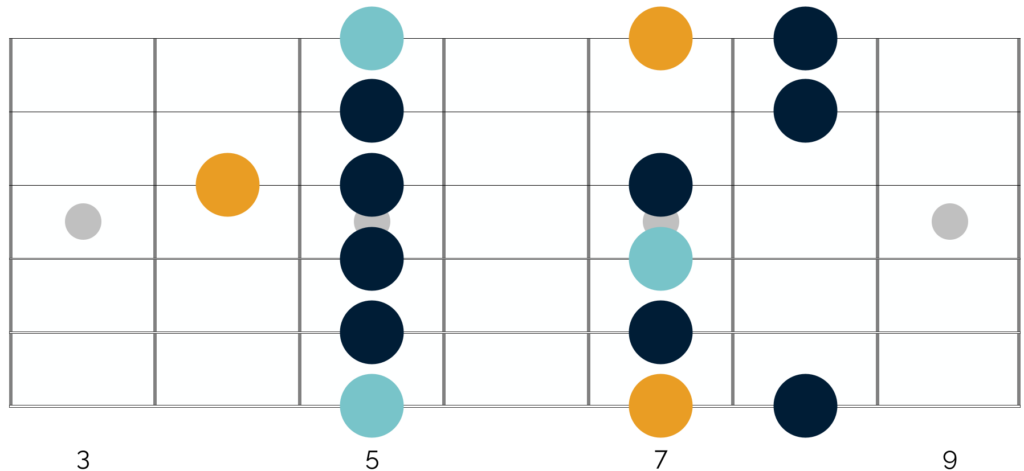
The tonic notes here are highlighted in light blue, and the “new” note that Healey adds into the mix is highlighted in yellow.
From a theoretical point of view, what makes this note so interesting is that it is a major interval that appears naturally in both major contexts — the major pentatonic, Mixolydian mode — and minor ones, such as the Aeolian and Dorian modes.
It is an extremely versatile note that sits comfortably across a wide range of harmonic situations without sounding jarring or out of place.
You will be able to find this note all over the fretboard of your guitar in any given key, but for now I’d recommend targeting it in just this single position.
There are a number of different ways that you can target the note which I think work really well. These are as follows:
1.) You can resolve directly to it, which will give your phrases a Santana-esque Latin quality.
2.) You can include it as part of a broader phrase, as Healey does, allowing it to add a touch of colour without dominating your licks.
3.) Finally, as the major 2nd sits just a semitone beneath the flat third of the minor pentatonic, you can bend up a semitone, moving from this new note into the familiar territory of the minor pentatonic.
The great thing is that the major 2nd is not a “risky” note to use or add to your playing. It doesn’t introduce significant tension or dissonance., it simply adds colour and can meaningfully enhance your blues soloing vocabulary.
My only word of caution is to be intentional in your approach. When you resolve to the note or target it in a meaningful way, it should be because you want to create that flavour, not simply because your fingers are leading you there in auto-pilot.
Bringing the blues power with bending
You can’t talk about any version of While My Guitar Gently Weeps without discussing bends.
Eric Clapton’s original — which in my opinion is itself a greatly underrated performance — is built almost entirely on the quality of his bending, giving the guitar the weeping quality that defines the song.
Healey’s approach is no different, and both of his solos in the song are full of bends of varying pitches and durations.
Here, though, I want to highlight two specific bending ideas that I love and which I think can work very well in your solos.
The root note bend
Healey opens his main solo by bending the root note of A, which is found at the 10th fret of the B string. This is something I typically advise students to treat with caution.
The root note is a point of resolution, and bending away from it without following certain parameters can sound unsettled in an unmusical way. This doesn’t create bluesy tension in the way we want, and can instead sound like you’ve just hit the wrong note.
However, when executed with the right approach, bending the root note is extremely powerful. There are two key steps you have to follow to bring it into your playing:
Firstly, you need to push the bend further than a typical tone bend — all the way up to the flat third, which is the next note up in the minor pentatonic scale. In the key of A, that means bending from fret 10 all the way up to the equivalent pitch of fret 13.
Secondly, and equally importantly, you need to be assertive. If you bend the root note slowly without reaching your target quickly, the sound is harsh and dissonant.
This is because you have disrupted the resolution of the root note, without having hit your target note. So you want to avoid landing in this “no man’s land” and instead get up to your target pitch quickly.
Once you gain confidence with this idea, you’ll start to hear it everywhere.
The iconic solo in Hotel California opens with exactly this idea in the key of B. Comfortably Numb does the same.
It is a powerful, authoritative way to begin a phrase, and developing the muscle memory to execute it cleanly will also do a great deal for your ability to land larger bends accurately across all areas of the fretboard.
Country-style bends
The second bending idea Healey uses — particularly around the upper positions of the neck — involves bending a note on one string while simultaneously adding a note on the string above using the little finger.
The specific instance in the solo occurs at the 15th fret of the B string, where Healey bends and then grabs the corresponding note on the high E string with his pinky.
This technique is common in rock and country playing, and it is a wonderful way of extracting more expression and movement from a single bend.
The concept is pretty straightforward: bend up on one string, add a note from your scale on the string above, then return to the bent note before continuing with your phrase.
You can apply this idea across a variety of positions and string combinations, and the results will vary depending on where you are on the fretboard.
Give it a go and listen out for the different flavours that it brings into your solos!
Play like a slide guitarist
It’s worth noting at this point that Healey had an unconventional playing style. He played a Stratocaster flat on his lap in a position similar to a lap steel guitar, with an overhand technique.
This is a totally different approach to the instrument and one that I wouldn’t recommend trying out (unless you’re already playing in this way!)
However it’s important to point out, as I think it influenced Healey’s playing, and the the way he structured both of his solos on this recording.
Throughout the intro solo and the main solo, Healey uses slides extensively — not just as an ornamental technique within individual phrases, but as a means of moving around the fretboard.
The main solo in particular features an amazing ascending passage where he uses slides to travel through the pentatonic positions, hitting notes and then moving up through the neck in a fluid, connected way that avoids the choppy quality that can sometimes come from jumping between shapes.
This is one of my favourite topics to teach – and you can find a full lesson on it here, if you’re interested and would like to dig a bit deeper.
The reason for this is that thinking laterally, and using slides to move between the pentatonic shapes rather than jumping abruptly from one to another, produces a completely different feel.
The transitions sound smooth, the musical line has momentum, and the fretboard starts to feel like a connected whole rather than a series of isolated shapes.
A good starting point for developing this skill is to take the top three strings of the pentatonic shapes and use the G string as a guiding thread. Here are how those notes appear on the fretboard:
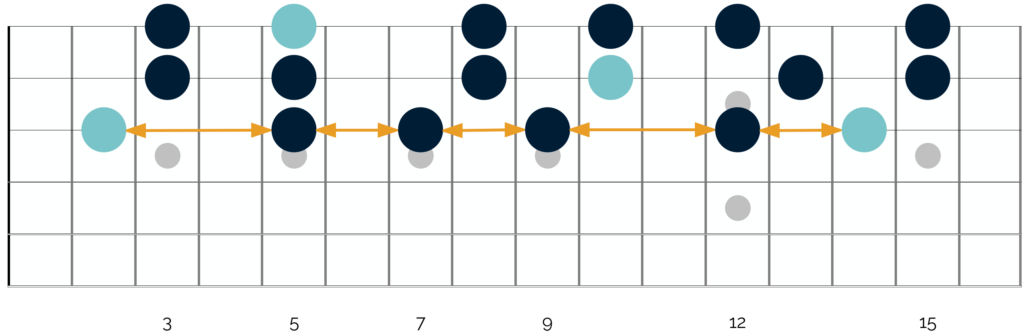
The tonic notes of A are shown in light blue, and the connecting “thread” on the G string is highlighted in orange.
Use this to move up and down along the G string between positions, anchoring your phrases on the B and high E strings as you go.
Initially this will feel mechanical, but it provides a clear map for how the shapes connect, and once the connections become intuitive you can start making the bigger, more dramatic jumps that Healey makes throughout this solo.
These will add vocality, expression and a sense of momentum and excitement to your solos, as well as providing you with an elegant solution for navigating across the fretboard.
Building speed with legato runs
The last concept I want to cover is speed.
Now, I’m not even close to being the fastest player around (not yet, anyway!) and right now, this song sits close to my technical limit. However I do believe that speed used selectively is a wonderful tool, and one that can add real life and intensity to a solo.
If you want to start getting faster, then a great place to start is with legato runs in the style that Healey uses in “While My Guitar Gently Weeps.”
The reason being is that using legato technique (hammer-ons and pull-offs) reduces the technical demand on your picking hand, and allows you to play fast without building so much synchronicity between your hands.
A good starting exercise is a simple descending pull-off run through the first pentatonic shape. In the key of A, this would begin on the high E string and work its way down, incorporating the blue note on the G string as you descend.
Here is what the tab for that looks like:

And at 80 bpm, the isolated guitar audio for this run sounds like this:
Once you are comfortable with that and can execute the run cleanly, the next step is to introduce a three-note grouping pattern — descending and then ascending — which adds complexity and starts to sound more like the kind of lines Healey is actually playing.
Here is what that looks like in the first shape of the A minor pentatonic scale:

As the notes here are played as triplets and the lick is faster, I’ve slowed this down to 60 BPM, so you can hear what’s happening:
Licks like this which are broken up into triplets are very common in blues-rock music, and they appear all of the time in the playing of guitarists like Rory Gallagher, Gary Moore, Joe Bonamassa and Stevie Ray Vaughan.
With both of these ideas, start slowly, use a metronome and build up the speed over time, never sacrificing precision or clarity in the process.
Closing thoughts
There we have it – some of the key lessons we can take from Jeff Healey’s version of “While My Guitar Gently Weeps” and use in our blues playing.
For me, what makes this version so special is not any single technique in isolation.
It’s the combination of classic minor pentatonic blues ideas, with the intelligent use of additional notes, expressive bending, fluid lateral movement, and intensity as a result of speed.
The four concepts covered in this article are ones that you can begin working on immediately, and each of them will have a meaningful impact on the quality of your improvisations well beyond this particular song.
As I always say, in blues it’s in the granularity that you find the real gold. So take each idea, spend time with it, and push it into new musical contexts.
I hope you found this useful.
Let me know how you get on in the comments below, and if you have any questions at all please do reach out on aidan@happybluesman.com — I would love to help.
Image – Alamy




Responses