
In many ways, the blues is a relatively simple genre.
It is often based around the same chord progressions, which typically only use 3 or 4 chords, and the soloing approach is also quite similar from song to song. In short, you can go a long way as a blues player without diving too deep into music theory.
That being said, understanding a few key concepts can totally change your journey as a blues guitarist.
You will start to see why certain chords appear in certain songs, you will be able to learn new material much more quickly, and you will play with a lot more confidence — whether you’re jamming, soloing over a backing track, or figuring out songs by ear.
When I first learnt this material, it totally changed my experience of the guitar. And I’m confident it will do the same for you too.
That’s what this article is about.
It covers three things: how chords are formed, how chord progressions work, and what all of this looks like specifically in the blues. It’s theoretically dense in places, but I promise it’s worth sticking with it.
Let’s dive in!
Part I: How chords are formed
To understand chords, we need to start with the major scale. This is a 7 note scale which forms the basis of most Western music.
We’ll use C major because it has no sharps or flats, which keeps things nice and simple. The notes in the scale are as follows:
C D E F G A B
If you are new to the major scale, then I would recommend reading my article ‘Getting Started With The Major Scale‘ before continuing here. In that article I cover the major scale and its shapes in depth.
This is what the notes of the C major scale look like when you play them laterally across your fretboard:
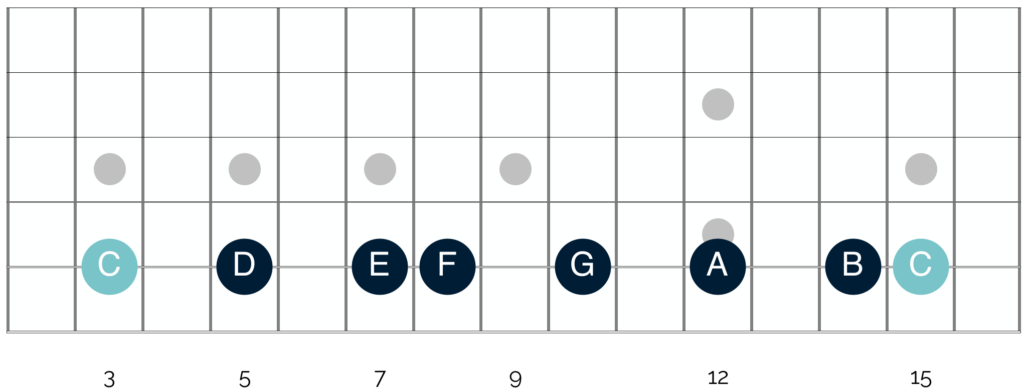
The tonic notes of C are highlighted here in light blue.
Building triads
Chords are built from the major scale using a process called stacking thirds.
This means combining notes that are separated by the interval of a third. The easiest way to think about this is: play a note, skip a note, play a note, skip a note, until you have three notes.
So starting on C: play C, skip D, play E, skip F, play G. That gives us C, E and G — a major triad.
A triad is a three-note chord in which each note is separated by a third interval. It’s the simplest type of chord you can build, and it’s the foundation of everything that follows.
We can repeat this process starting on any note in the scale. Starting on D: play D, skip E, play F, skip G, play A. That gives us D, F and A — and this time, we end up with a minor triad.
If intervals are a new concept for you, I’d recommend heading over to this article on intervals before continuing. It covers how intervals work and the different types you encounter on the guitar.
Major vs. minor triads
Even though we followed the same process of playing and skipping notes, in one instance we end up a major triad and in another a minor triad.
This is because the specific distances between the notes in each triad are different.
This might sound complicated, but it makes sense when we lay out the notes of each of these two chords horizontally across the fretboard. Here are the notes of the C major chord:
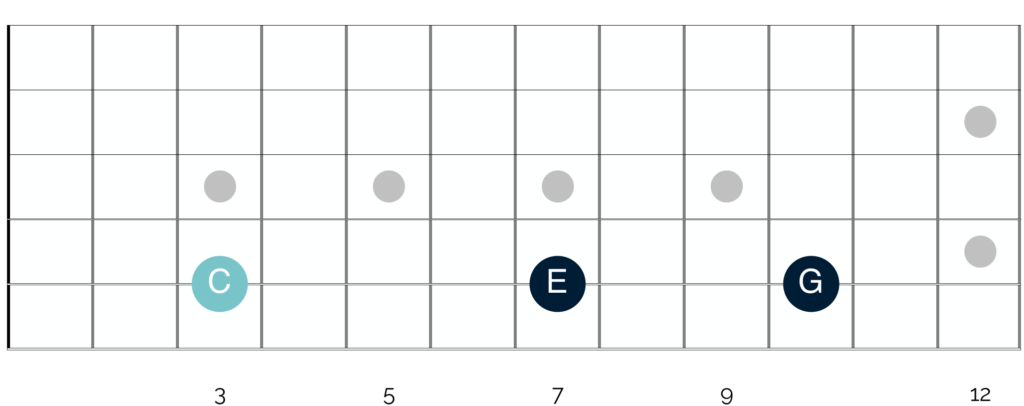
As you can see:
- The notes of C and E are separated by 4 frets
- The notes of E and G are separated by 3 frets
- The total distance between the first and last note of the chord is 7 frets
This changes when we look at the distances between the notes that appear in the D minor chord:
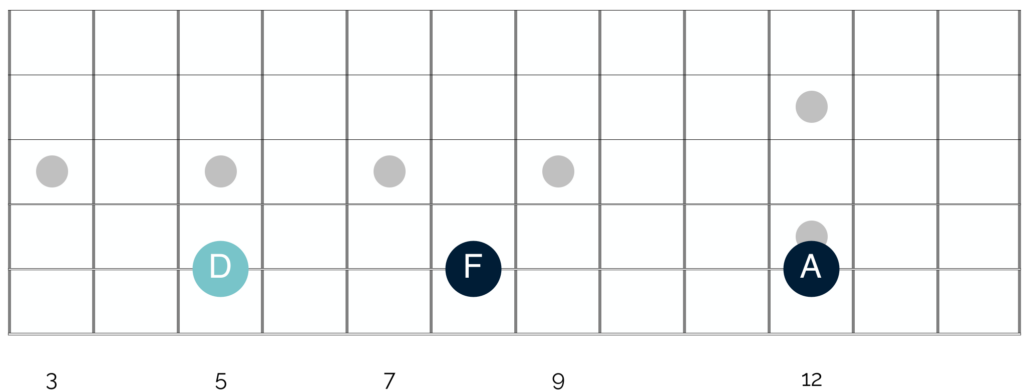
Here you can see that the intervals between the notes have changed:
- There are only 3 frets (not 4) between the notes of D and F
- The distance between the notes of F and A is 4 frets, not 3
- The total distance between the first and last note of the chord is the same as in the C major triad – 7 frets
These differences are explained by just a single shift:
In a major chord, the interval from the first note to the middle note of the chord is a major third — or four frets on the guitar.
In a minor chord, that same interval is a minor third — three frets.
The total distance from the first note of the chord to the top note of the chord is the same in both cases (seven frets, a perfect fifth).
The intervals in each of these chords are as follows:
Major chord – 1 3 5
Minor chord – 1 b3 5
So the only difference between a major chord and a minor chord is that single note, which is always 1 fret lower in a minor chord.
It is for this reason that major and minor chord shapes are always only separated by a single fret:
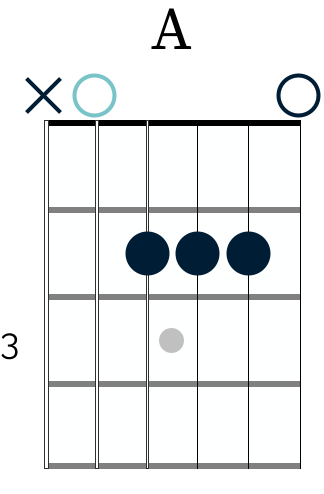
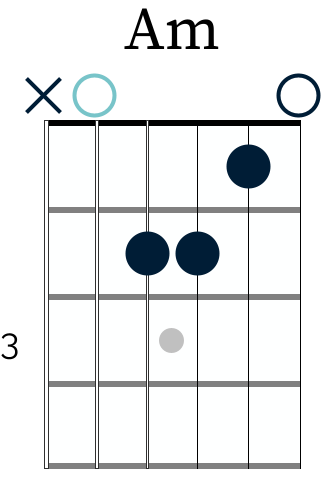
Once you understand that connection, you can stop thinking of major and minor chords as completely separate chord shapes and can instead start seeing the relationship between them.
Part II: How chord progressions work
If you follow that same process for every note of the C major scale — building a triad off each degree — you end up with seven different chords.
Because the spaces between the notes of the scale aren’t all equal, you end up with a mix: some major chords, some minor chords, and one diminished (more on that shortly). Here’s what the full set looks like in C major:
| Note name | C | D | E | F | G | A | B |
| Notes in triad | C E G | D F A | E G B | F A C | G B D | A C E | B D F |
| Type of triad | Major | Minor | Minor | Major | Major | Minor | Diminished |
| Chord | C Major | D Minor | E Minor | F Major | G Major | A Minor | B Diminished |
| Triad / chord number | I | ii | iii | IV | V | vi | vii° |
There is a lot of information in this table to dissect, but the key point to takeaway is the type of chord built on each note or degree of the scale.
Put another way, when you harmonise the first note of the major scale you end up with a major chord. On the second note you end up with a minor chord, on the third a minor chord, and so on.
This is the same regardless of which major key you’re in. The order of chords and the way that they are represented is as follows:
| Degree | I | ii | iii | IV | V | vi | vii |
|---|---|---|---|---|---|---|---|
| Quality | Major | Minor | Minor | Major | Major | Minor | Diminished |
Upper case Roman numerals represent major chords. Lower case Roman numerals represent minor chords.
So the I chord is major, the ii chord minor and so on.
This is what provides you with the framework for understanding songs.
When someone says “we’re playing a 1-4-5 in the key of C,” you know you need to play a C major, F major and then G major chord.
If we switched to the key of G major, the pattern of chords would be the same. So the I chord would be major and the ii chord minor etc. The only difference is that the I chord would be G major, the ii chord would be A minor and so on.
The diminished chord
The chord built off the 7th degree sounds particularly tense and unresolved.
The reason is that while every other chord in the scale has a perfect fifth between its lowest and highest note (seven frets), this chord has a flat fifth — only six frets.
You can see this when the intervals of the chord are shown laterally across the fretboard like this:
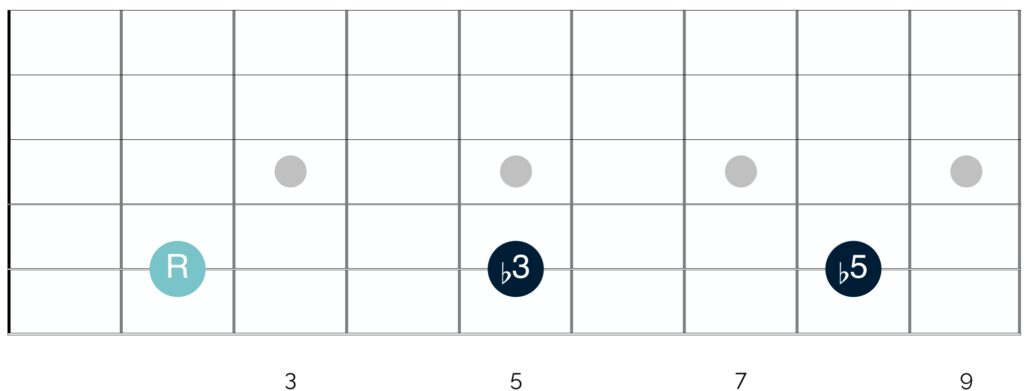
That flat fifth creates a lot of tension and dissonance, and gives diminished chords quite an unstable sound.
You will encounter diminished chords in the blues, and they sound great in the right context. But they are used far less frequently than the other six chords, so we won’t dig into them much more here.
Part III: Seventh chords and the blues form
If you take a 1-4-5 in C major — C, F, G — and play them as basic major triads, it sounds nice, but it’s lacking that bluesy sound we know and love.
The reason for this is that blues music is typically not based around major chords, but rather dominant 7th chords.
To understand what these are and how they work, we need to return to our chord-building process of stacking notes from the major scale.
Now though, we add one more note into the mix – creating chords with 4 individual notes. As we do this, we create a series of what are known as 7th chords.
Every time we add a note to a major chord in this way we end up with a major 7th chord. When we do this with a minor chord, we end up with a minor 7th chord.
The intervals in each of these chords are as follows:
- Major 7th chord – 1 3 5 7
- Minor 7th chord – 1 b3 5 b7
If we follow this process with the notes of the major scale, then when we get to the 5th degree (the note of G in C major) we end up stacking together the notes G, B, D and F.
The G-B-D part is a standard major triad. But that final note, F, sits a minor third above D, not a major third. That gives us the interval formula: 1, 3, 5, b7.
This is what gives dominant 7th chords their slightly tense and unresolved quality — the major intervals of the triad underneath, with a minor interval on top. That’s the bittersweet sound at the heart of the blues.
The blues I, IV, V
Blues music is typically based around the I, IV and V chords in this framework.
The key difference is that it takes those chords and turns them all into dominant 7th chords.
So instead of C major, F major, G major — which sounds nice but not particularly bluesy — we play C7, F7, G7.
That is the blues form, and the starting point for thousands of the famous blues songs that have been written over the years.
Some people think of the blues as its own separate thing, disconnected from everything we’ve just covered.
Personally though I prefer to think of it as a twist on the major scale system — you follow the logic, build the progression, and then the blues says: “right, now take the I, IV and V and turn them all into dominant 7th chords“
This is the progression that you’re going to encounter most frequently in the blues, and which forms the starting point for almost all famous blues songs.
Putting it all together
Don’t worry if this feels like a lot to take in right now.
It took me a long time to wrap my head around all of this at first.
In fact what I would typically recommend is that you don’t rush to absorb all of this in one go, and instead keep the key points in mind as you encounter songs and progressions and come back to this article every now and again as a refresher if needed.
And with that in mind, here are the key takeaways from this lesson for you to focus on and return to:
- A triad is a 3 note chord, in which each note of the chord is separated by a third interval
- The intervals in a major triad are 1 3 5
- The intervals in a minor triad are 1 b3 5
- You create chord progressions by harmonising the notes of the major scale and you always end up with the same kind of chords in the same order (major, minor, minor, major, major, minor, diminished)
- The intervals in a major 7th chord are 1 3 5 7
- The intervals in a minor 7th chord are 1 b3 5 b7
- The intervals in a dominant 7th chord are 1 3 5 b7
- Blues music is typically based around. the I, IV and V chords in a progression, but each of those chords is played as a dominant 7th chord
If you want to go deeper on any of the ideas here, I’ve written separate articles on dominant 7th chords, the blues form, and intervals on the guitar that I think you’ll find helpful.
And if you have any questions at all, drop them in the comments below — I’d love to help.
Otherwise, good luck getting to grips with these concepts, and I’ll see you in the next one! 😁
References & Images
Unsplash, Guitar Habits, Wikipedia, Hello Music Theory, Music Notes Now, Wikipedia, Puget Sound, Open Music Theory, Guitar Theory For Dummies, Modern Music Theory For Guitarists




Responses
Really enjoyed and got a lot from this, have you published the next one yet?
Thank you so much for the kind words Paul, I really appreciate it and I’m very glad to hear that you found the article helpful.
The next step of this article isn’t published just yet, but I’ve started work on it and so will be adding it to the site in the next month. So keep an eye out for that, and if I can help with anything in the meantime, just let me know. You can reach me on aidan@happybluesman.com and I am always around and happy to help! 😁
Great article. I’ve been looking for just this kind of explanation, to help me with my bass playing. Understanding chord construction will assist me in building better bass lines to complement what the guitarist is doing. Well done!
Thank you so much for the kind words Ray and I’m really glad to hear that you found it helpful. Best of luck building those bass lines! 😁
I’m beginning to under stand .using theory thank you
That is brilliant news Ike, I am so glad to hear that you found the article helpful! 😁
I absolutely appreciate your lessons here on this site. I have been playing guitar and bass at a pro level for 50 years. I had a vague grasp of these fundamentals, but after reading thru some of your plans here, it has become clear to me now what I have been doing all these years. Starting at age 10, early on I grasped the scales and chord patterns but never knew the science or math behind the theory. Thank you very much.
Great article! It cleared up a lot for me. Easy to read and understand. Thanks!
Thanks for the kind commend Raymond and I am so happy to hear that you found it useful. From my perspective, feeling comfortable with chord theory does a lot to increase your understanding of both the guitar and music in general, and I really hope that it’s helping your playing! 😁