
Like many of the box shapes that we encounter in the blues, the B.B. King Box is technically not providing us with any new information. It is simply a collection of 6 notes that King consistently targeted in his playing, which gave his licks a unique sound.
In the key of G – which is the key that I use in all of the examples throughout this course – the B.B. King Box is as follows:
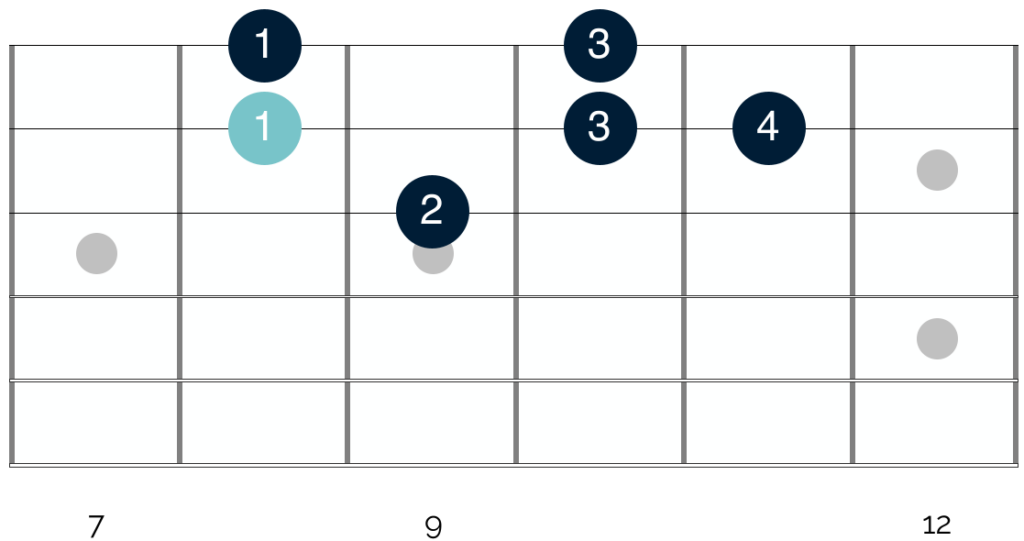
The tonic note of G is shown in light blue, and the suggested fingers I would use to play the box are also illustrated on the diagram.
Now, as mentioned around the 1.55 minute mark in the video above, I typically like to extend the B.B. King Box to also include these 2 notes:
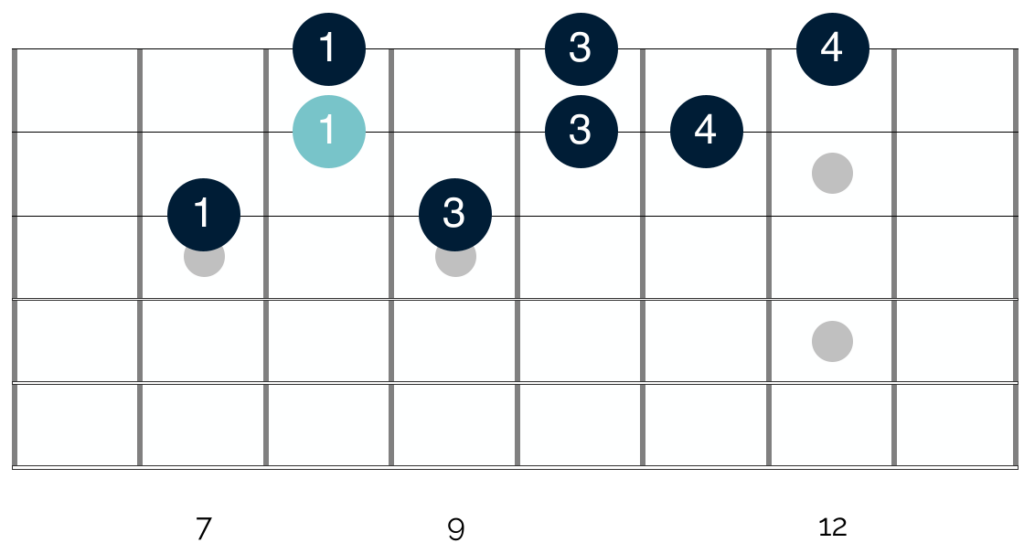
I do this because I feel it offers you more options when it comes to actually using the box shape practically. Not only this, but the ‘new’ notes that are being added into the box here, are in fact not new at all.
The note at the 7th fret of the G string is the note of D. This is the exact same note that you will find at the 10th fret of the high E string. It is simply an octave lower.
Likewise, the 12th fret on the high E string which we have added in is the note of E. This is the exact same note that you will find at the 9th fret of the G string. It is simply an octave higher.
Don’t worry too much about these extra notes for now. As we continue through these lessons, you will learn licks that make use of these notes and build confidence extending the box shape as shown in the second diagram.
For now though, let’s look at what is happening in the B.B. King Box from an intervallic perspective.
Understanding intervals
As already mentioned, the B.B. King Box mixes elements of the major and minor pentatonic scales. This means that some of the intervals in the box shape are major, and others minor.
The intervals in the B.B. King Box are as follows:
1 2 b3 4 5 6
When we see these on the fretboard in the order in which they are played, they are as follows:
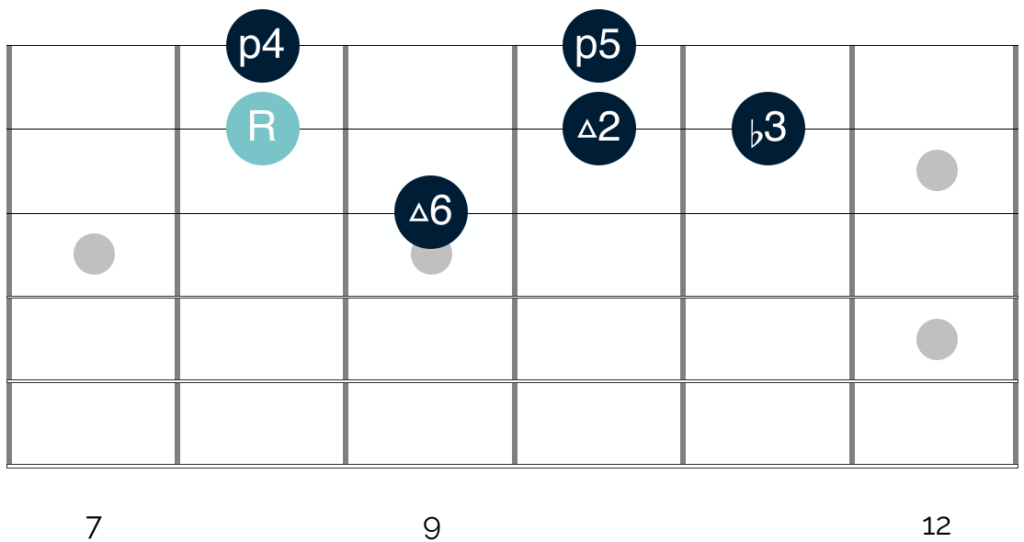
So you start on the major 6th, then play the tonic note (in this case G) and move on from there. This example is in G, but these intervals appear in this exact order, regardless of the key in which you are playing.
So the intervals would be the same if this were in the key of A or E, it is just their position on the fretboard which would change.
Now, if you don’t feel fully comfortable with intervals, don’t worry! You don’t need to know all of the theory to use the box in your playing.
In fact, there are just two significant points you need to take into account, which are as follows:
The major & minor mix
The 2 and 6 are intervals that appear exclusively in the major pentatonic scale. Conversely, the b3 and 4 are intervals which appear exclusively in the minor pentatonic scale. The tonic note and the 5th appear in both scales.
In overly simplistic terms, the intervals found just in the major pentatonic scale have a warmer and more upbeat sound. The intervals found in just the minor pentatonic scale perform the opposite function and have a more aggressive and melancholic sound.
Arguably the most powerful interval in the B.B. King Box is the b3. This creates a very strong minor sound that has the potential to totally alter the feel of the licks you play. Without this interval, the box shape has a much warmer sound.
When you play using the B.B. King Box, you are mixing the sound of the major and minor pentatonic scales. To begin with, it is likely that you will be targeting this mix without thinking too much about what you are playing.
However with time and as you get more confident with the box and where the various intervals appear, you can begin to be more intentional with your note choices.
You can do this by learning where specific intervals appear in the box, by listening to the quality of each note (does it sound major or minor?), or by adopting both of these approaches together.
Musical context
The second important point to understand – without getting too deep into the theory – is that it is much safer to play the B.B. King Box in a major blues context.
Although the B.B. King Box does contain a b3 interval (which is minor in tonality), there are certain major intervals in the box which can cause quite a spicy and dissonant sound over a minor chord progression.
Whilst you could play over a minor progression and avoid these intervals, the purpose of this box shape is that it provides you with a neat bundle of notes to target in your solos. So having to avoid some of the notes within that box somewhat defeats the purpose of targeting the box in the first place.
So, for now – use the B.B. King Box when you are playing in a major key, or over a major blues progression composed of 7 chords. (These would be G7, C7 and D7 in the key of G).
Targeting the notes of the B.B. King Box
Once you feel comfortable with the notes of the B.B. King Box, you can get into the good stuff – crafting licks that use the notes of the box!
I run through how I approach this with each of the notes of the B.B. King Box from around the 6.20 minute mark in the video above. In summary though, I recommend the following:
Major 6th – For me, this represents a great “launching in note” for the box shape. I typically play this with my middle finger. This puts the other fingers of my fretting hand into the best position to play the other notes in the box. However it also means that the middle finger becomes less suitable for bending, and so is better suited as a note to be played without too much technique.
Root Note – Likewise, the root note doesn’t offer a great deal of opportunity for technique. This note creates a strong sense of resolution, which you typically don’t want to disrupt by bending or altering its pitch too much. Instead I would recommend resolving your phrases on this note, and applying a bit of gentle vibrato to bring it to life.
Major 2nd – Here things start to get a bit more interesting. If you bend this note up a whole tone, you will reach the pitch of the major 3rd interval. So you will start with a warm and major sound, and then continue with that same sound as you bend up to the major 3rd.
Conversely, if you bend that note just a semitone, you will reach the b3 interval. This creates a much more melancholic sound, and moves you from a major tonality, into a minor tonality.
Minor 3rd – You also have a variety of different options when it comes to targeting the minor 3rd. The first of these is to bend up a whole tone to reach the perfect 4th. The 4th is another note from the minor pentatonic scale, and so bending in this way keeps you well within the sound of the minor pentatonic scale.
Conversely, if you bend that note just a semitone, you will reach the major 3rd interval. This movement – from the b3 to the 3rd – happens all of the time in the blues. So it will help you to mix the major and minor tonalities and do so in a way that sounds classically bluesy.
Perfect 4th – Technically, you can bend this note up a whole tone into the perfect 5th. However doing so creates quite an aggressive sound that is more reminiscent of Albert King’s style than of B.B. King. As such, I typically avoid bending this note, and use it simply as a note to play within the box, and to target with hammer ons, pulls offs and slides.
Perfect 5th – When it comes to the final note of the box shape, I typically recommend bending up a whole step to the major 6th. Both of these notes are found within the major pentatonic scale, and so this will allow you to create a warm and upbeat sound in your licks. You can also slide and execute hammer ons and pull offs between these notes.
These suggesting of course are here to just offer a starting point. Over the next lessons we’ll dig into these ideas in much more detail and look at how you can use them – in combination with other techniques, scales and positions on the fretboard – to create a wide range of licks and beautifully mix the sound of the minor and major tonalities.
So, once you feel comfortable with what the B.B. King Box is and how it works, head over to the next lesson and let’s dive into more of the playing! 😁